Mon to Sat 7:00am to 9:00pm, Sun 9:00am to 9:00pm

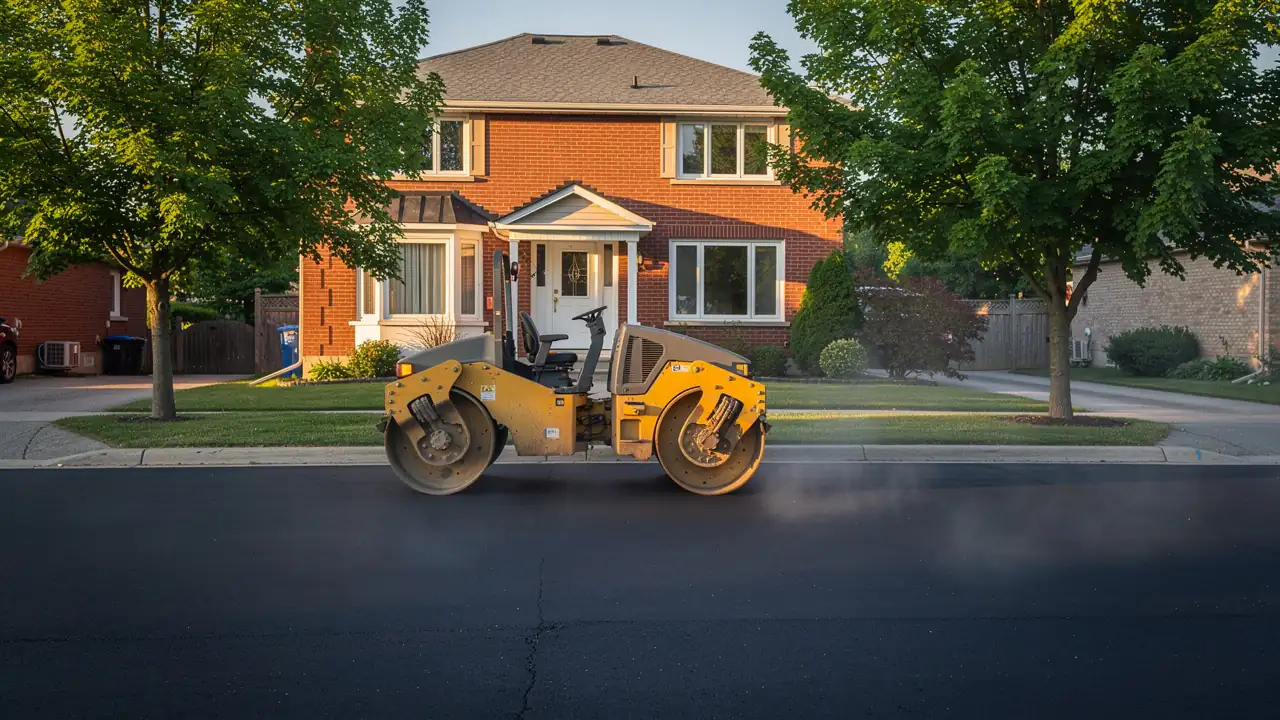
Double drum roller on fresh Kitchener asphalt

Kitchener asphalt contractor

About Kitchener Asphalt Paving Pros, Asphalt Contractor in Kitchener Since 2013

Kitchener Asphalt Paving Pros is a local asphalt contractor that has paved, rebuilt and repaired surfaces across Waterloo Region since 2013. In 14 seasons our crews have completed more than 2,500 jobs, from single-car driveways in older Kitchener neighbourhoods to condo roadways and farm laneways.

This page explains how we work: the credentials you can check, the equipment on our trucks, the build standard behind every quote and the exact terms of our 1-year labour warranty. It is written for homeowners, property managers and condo boards who want to know who they are hiring before the first site visit.

Every number here, from 150 mm of Granular A to a 2% slope, is written into our contracts so you can hold us to it.

Our story

Our Story: Paving Waterloo Region Since 2013

We have paved out of Kitchener since 2013, and 2026 is our 14th season. The shop on Stirling Avenue South sits near the Rockway and Mill-Courtland neighbourhoods, a few minutes from the Conestoga Parkway, which puts most Kitchener streets 5 to 20 minutes from our door.

Over those seasons the job count has passed 2,500, and our typical paving projects by neighbourhood and town show what that work looks like. The work is a mix of residential and commercial asphalt: driveways, carports and walkways for homeowners, and parking lots, private roads, industrial yards, curbs and speed bumps for property managers, condo boards, churches and farms.

We also take on work many paving companies do not offer, including heated driveways with electric or hydronic snowmelt, tennis and basketball court paving, asphalt floors for garages and pole barns and hot asphalt flat roof repairs.

We are asphalt specialists only. When a project also needs concrete steps, interlock borders or parking lot line painting, we coordinate with those trades rather than doing that work ourselves.
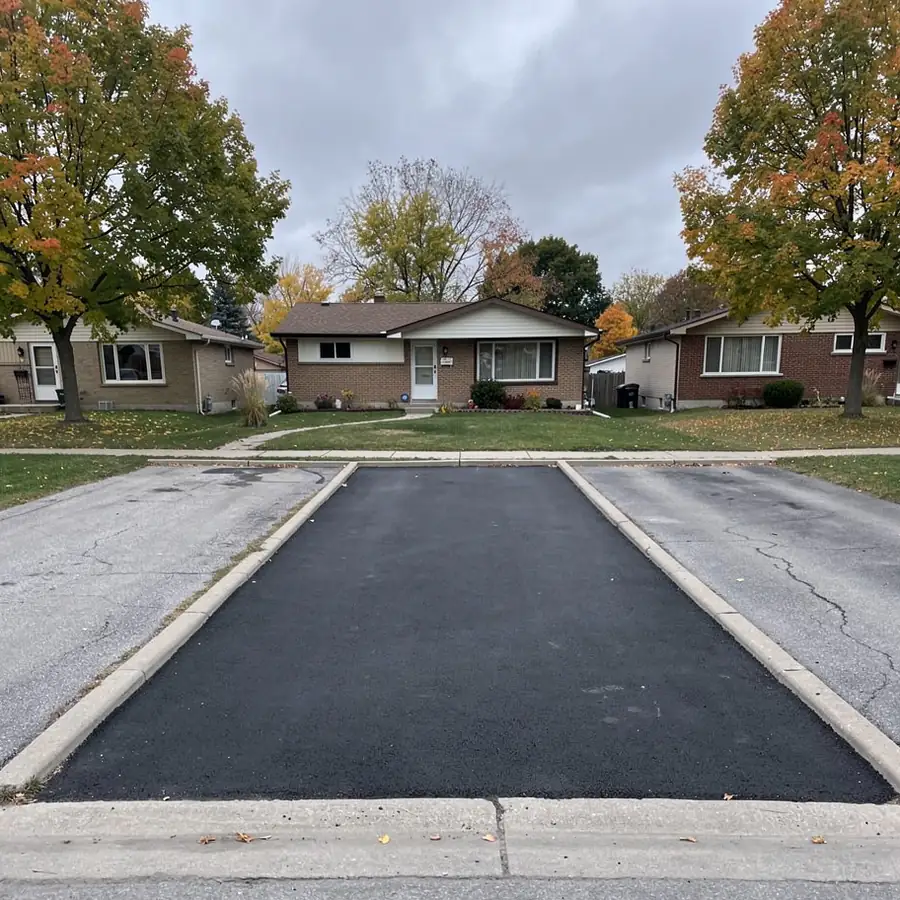
Row of newly paved Kitchener driveways

Our people

Who You Will Meet on Your Job Site

Our crews work under Ontario's Occupational Health and Safety Act, with traffic cones, barricades and high-visibility vests set up before the first truck arrives. Here is who you deal with from the first call to the last walk-around.

The estimator at your site visit

The site visit is where your job is really designed. We measure the area, probe the base for soft spots, note where downspouts and the lawn send water, and check the curb, boulevard and any widening plans.

Within 2 business days you get an itemized written quote listing base depth, asphalt thickness, mix and the drainage plan.

The crew lead on paving day

A crew lead runs the site on paving day and checks the compacted base before any hot mix is placed. Before the trucks leave, they walk the finished surface with you and go over the curing rules for your driveway or lot.

The office, seven days a week

Questions about scheduling, locates or permits go to the office at 548-457-2043 or info@kitchenerasphaltpaving.ca. We answer Monday to Saturday from 7:00am to 9:00pm and Sunday from 9:00am to 9:00pm.

Licensed trades we coordinate

Electric snowmelt needs a Licensed Electrical Contractor who files a notification with the Electrical Safety Authority, and hydronic boilers need a TSSA-registered gas contractor. We schedule those trades around our paving so the system is in place before hot mix goes down.

Credentials

Licences, Insurance and WSIB Coverage

We are licensed and insured, carry an active WSIB account and put a 1-year labour warranty in writing on every job. You can check each of these yourself before you sign anything.

WSIB Clearance Certificate

A WSIB clearance certificate confirms that a contractor's account with the Workplace Safety and Insurance Board is active and in good standing. It means the crew on your property is covered by Ontario's workplace insurance system, and businesses that hire a contractor without clearance can be held liable for premiums that contractor owes.

Look us up any time with WSIB's online clearance certificate search. We also email a current certificate on request, usually the same day.

Liability Insurance Coverage

We carry commercial general liability insurance on every residential and commercial job. Property managers, condo corporations and plaza owners can request a certificate of insurance that names them as additional insured.

Commercial sites often need that certificate on file before a crew is allowed on the property, so ask for it with your quote.

Safety Training and Site Programs

Safety on a paving site comes down to hot material, heavy rollers and traffic. These are the standards our crews work to:

  • Site work under the Occupational Health and Safety Act and Ontario Regulation 213/91 for construction projects
  • Cones, barricades and high-visibility vests on every site
  • Ontario Working at Heights training for our flat roof crews
  • Free utility locates through Ontario One Call before any digging, as the Ontario Underground Infrastructure Notification System Act, 2012 requires

Equipment

Our Equipment and Where Our Asphalt Comes From

Here is the equipment our crews bring to a job and why each piece matters to the finished surface. Hot mix comes from local asphalt plants in Waterloo Region and the Guelph area, a short haul that keeps it hot until it is rolled.

Hot mix from nearby plants

Surface lifts are HL3, an Ontario surface mix under OPSS 1150 with 13.2 mm maximum stone, and heavier work adds an HL8 binder lift with 19 mm stone underneath. The binder is a performance-graded asphalt cement chosen for Ontario's temperature swings, typically PG 58-28.

Asphalt paver

A self-propelled paver spreads hot mix at an even depth across the full width, which hand raking cannot match on a driveway or lot. Its heated screed leaves a uniform texture with no rake marks or thin spots.

Double-drum vibratory rollers

Rollers from 1.5 to 3 tonnes compact the mat while it is still above about 85 C, below which hot mix stops consolidating properly. Vibratory plate compactors handle edges, walkways and corners the roller cannot reach.

Skid steer with breaker and milling head

The breaker lifts old asphalt for recycling, and the cold planer mills clean tie-ins at garage slabs and street edges so an overlay meets them flush. The same machine grades and spreads Granular A on tight residential lots.

Curb machine

Our curb machine extrudes continuous asphalt curbs along lot edges and islands. They steer runoff toward catch basins and keep vehicles off landscaping.

Infrared heater and hot box

The infrared unit heats a damaged area until it can be raked and blended with fresh mix and rejuvenator, so the repair has no cold seam for water to enter. An insulated hot box keeps that mix workable for hours, which is what makes small infrared asphalt repairs practical.

Dump trucks handle removal and stone delivery, and a hot-water pressure washer with a surface cleaner is used for asphalt power washing before sealing.

Build standard

The Build Standard Written Into Every Contract

Our standard residential driveway is 150 to 200 mm (6 to 8 in) of compacted Granular A under 60 mm (2.5 in) of compacted HL3, sloped at least 2% away from the house. Heavier traffic gets a deeper base and a second lift, and every quote states which row of this table your job is built to.

Minimum build specs by job type
JobGranular base (compacted)Asphalt (compacted)
Residential driveway, cars150 to 200 mm (6 to 8 in) Granular A60 mm (2.5 in) HL3, one lift
Driveway with an RV, work truck or trailer200 to 250 mm (8 to 10 in) Granular A50 mm HL8 + 40 mm HL3, two lifts
Walkways and paths100 to 150 mm (4 to 6 in) Granular A50 mm (2 in) HL3 or HL3F
Garage and shop floors150 to 200 mm Granular A50 mm HL8 + 40 mm HL3
Parking lot, car traffic150 mm Granular A over 300 mm Granular B50 mm HL8 + 40 mm HL3
Truck lanes, loading and garbage pads150 mm Granular A over 450 mm Granular B60 to 75 mm HL8 + 40 mm HL3
Tractor-trailer yardsEngineered designTwo HL8 lifts + HL3, per the site engineer
Private roads and laneways150 mm Granular A over 300 mm Granular B50 mm HL8 + 40 mm HL3, or RAP for rural lanes
Sport courts150 to 200 mm Granular A, laser-gradedTwo lifts, HL3 then HL3F

Is 2 inches of asphalt enough? Fifty millimetres (2 in) of compacted HL3 is the minimum for cars on a sound base, which is why we lay 60 mm as standard. Thickness matters less than the stone under it, and a thin base is the most common reason driveways here fail early.

Granular A is crushed stone graded 19 mm and down, placed to OPSS 1010 and compacted in lifts until it stops moving under the roller. On roads, lots and soft ground we add Granular B Type I or II as a subbase, and on wet clay a non-woven geotextile keeps the stone from pumping into the soil.

Commercial bases are proof-rolled and can be tested to 100% Standard Proctor density when the engineer asks. Large lots and industrial yards follow the owner's civil engineer or geotechnical report, and we build to that design.

Built this way and maintained, a driveway in Waterloo Region lasts 15 to 25 years and a commercial lot on an engineered base 20 to 30 years.

Our process

How We Build a Driveway, Layer by Layer

A residential replacement follows the same six stages whether it takes one day or two. These stages are where cheap paving jobs usually cut corners, so they are also the right things to ask any contractor about.

  1. Locates and excavation

    Ontario One Call marks buried gas, hydro, water and cable lines first, which usually takes up to 5 business days. Old asphalt then goes to recycling, and excess soil goes to approved sites under Ontario Regulation 406/19.

  2. Subgrade check

    With the old surface off, we roll the native soil and dig out any spot that pumps or ruts. Geotextile fabric goes down wherever the clay is wet or soft.

  3. Granular A in lifts

    Stone goes down in layers, and each layer is compacted with a vibratory roller or plate before the next. One thick load of gravel compacted only on top is the shortcut that leads to sinking.

  4. Grading for drainage

    The base is shaped to at least a 2% fall, about 1/4 in per foot, toward the street, the lawn or a drain. We flag downspouts that empty onto the driveway so the slope carries that water off.

  5. Tack coat and hot mix

    SS-1 tack coat goes on saw-cut edges and any asphalt we pave against so the new layer bonds. The paver places the mix while it is between about 135 C and 160 C.

  6. Rolling, joints and edges

    The rollers finish compaction before the mat cools below about 85 C, then edges are hand-tamped to a clean bevel. The crew checks the finished slope for any spot that could hold water.

Experience

What 2,500 Jobs Have Taught Us About Local Pavement

Most driveway failures we are called to fix in Waterloo Region come from the same few causes, and almost none of them are the asphalt itself.

Clay that holds water

Much of Kitchener sits on clay and silt till, and the frost line here is about 1.2 m (4 ft) down. No driveway is dug that deep, so a free-draining, compacted granular base is what stops frost heave, not extra asphalt.

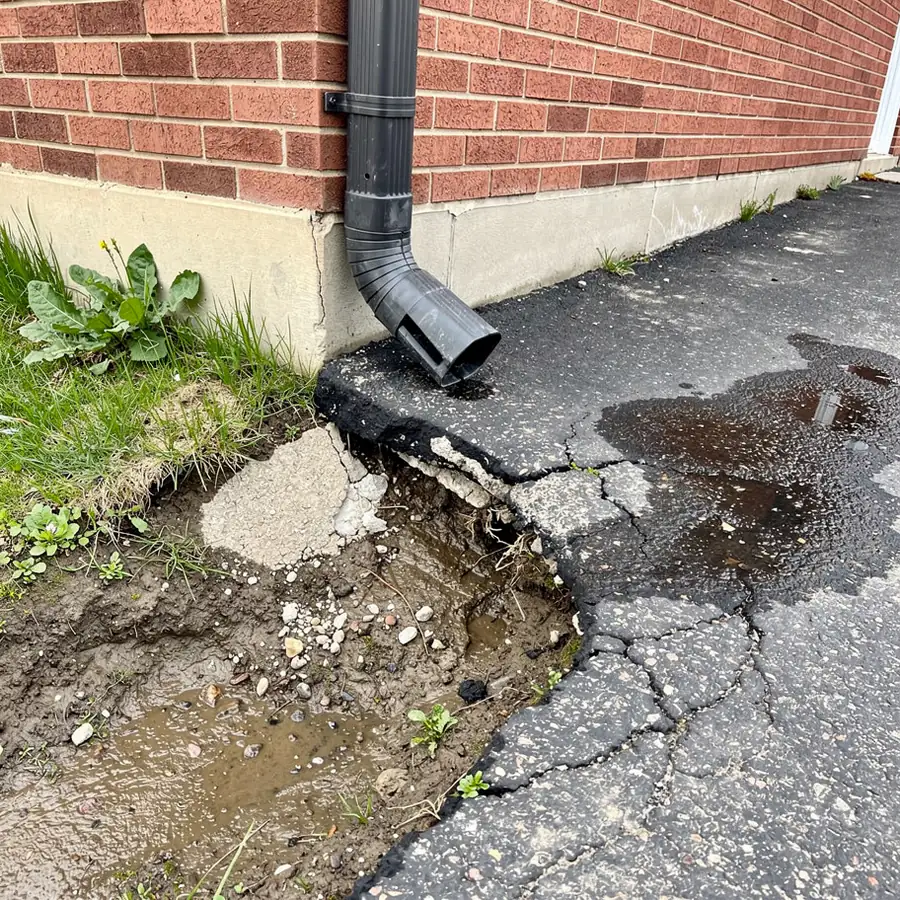
Downspouts aimed at the driveway

A downspout that empties onto asphalt soaks the base at one corner every time it rains. That corner is usually the first to crack and sink.

Thin builder-grade driveways

In newer subdivisions such as Rosenberg and Lackner Woods, many builder driveways start with a base coat only. Paving the top lift before the lot settles locks in dips that later hold water, so we check for settlement first.

Plows, salt and parked trailers

Snowplow blades gouge edges, road salt speeds up ravelling on unsealed asphalt, and a trailer jack left in one spot in July sinks into the soft surface. None of these are workmanship defects, which is why our warranty exclusions name them.

Overlays on failed bases

An overlay laid on a failed base cracks along the old lines, often within a few years. When the base is the problem, we quote driveway removal and replacement even though asphalt resurfacing would be the cheaper number.

Downspout washout cracking edge of driveway

Warranty

Our 1-Year Labour Warranty, in Plain Terms

Every job we build carries a 1-year labour warranty that starts on the completion date and is printed on both the quote and the invoice. If a defect comes from our workmanship, we repair the affected area at no charge.

Most arguments over paving warranties come from vague wording, so ours lists exactly what is and is not covered.

What the warranty covers

For 12 months from completion, we cover workmanship defects in work we built:

  • Cracking or settling caused by our base preparation or compaction
  • Puddles deeper than about 6 mm (1/4 in) on a surface we graded
  • Ravelling, meaning loose stones coming off the surface, from poor compaction
  • Open seams at joints we paved
  • Patches and crack fills that fail because of how we applied them

What it does not cover

These are not workmanship defects, so the warranty excludes them:

  • Tire scuffs and power-steering marks on fresh asphalt
  • Damage from parking in one spot, or from jacks, kickstands or trailer stands in hot weather
  • Oil, gas and chemical spills
  • Snowplow damage and tree roots
  • Settling or cracking from a base we did not build, such as reflective cracks through an overlay chosen instead of replacement
  • Vehicles heavier than the job was specified for
  • Normal sealcoat wear

Transfer to a new owner

If you sell the property within the 12 months, the warranty transfers to the new owner. Give the buyer your invoice, since it shows the completion date and the work covered.

How to make a warranty claim

Call 548-457-2043 or email info@kitchenerasphaltpaving.ca with photos of the problem and your address. During paving season we inspect within 7 days.

If the defect is ours, the repair is booked for the next suitable paving weather at no charge. If it falls under an exclusion, we explain the cause and can quote a fix if you want one.

Ontario's rules on written contracts, estimates and deposits are summarized in the Ontario guide for home renovation businesses. Our asphalt paving FAQ covers the questions we hear most about warranty, deposits and insurance.

Free quote

Talk to a Local Paving Crew About Your Project

Book a site visit and you will see the build standard on this page applied to your property, with base depth, lift thickness and slope written into the quote. Before you decide, read how to check our reviews and vet any paver.

  • WSIB clearance and insurance certificates sent on request
  • Base depth, mix and thickness listed in writing
  • Warranty coverage and exclusions explained before you sign
Shop
324 Stirling Ave S, Kitchener, ON N2M 3H6
Monday to Saturday
7:00am to 9:00pm
Sunday
9:00am to 9:00pm
Call 548-457-2043Free Quote