New installations
Bumps for slow areas such as lot aisles and drive-thru exits, humps for private roads, and tables at crosswalks. Each is laid on existing asphalt or keyed into it, during paving or as a separate visit.
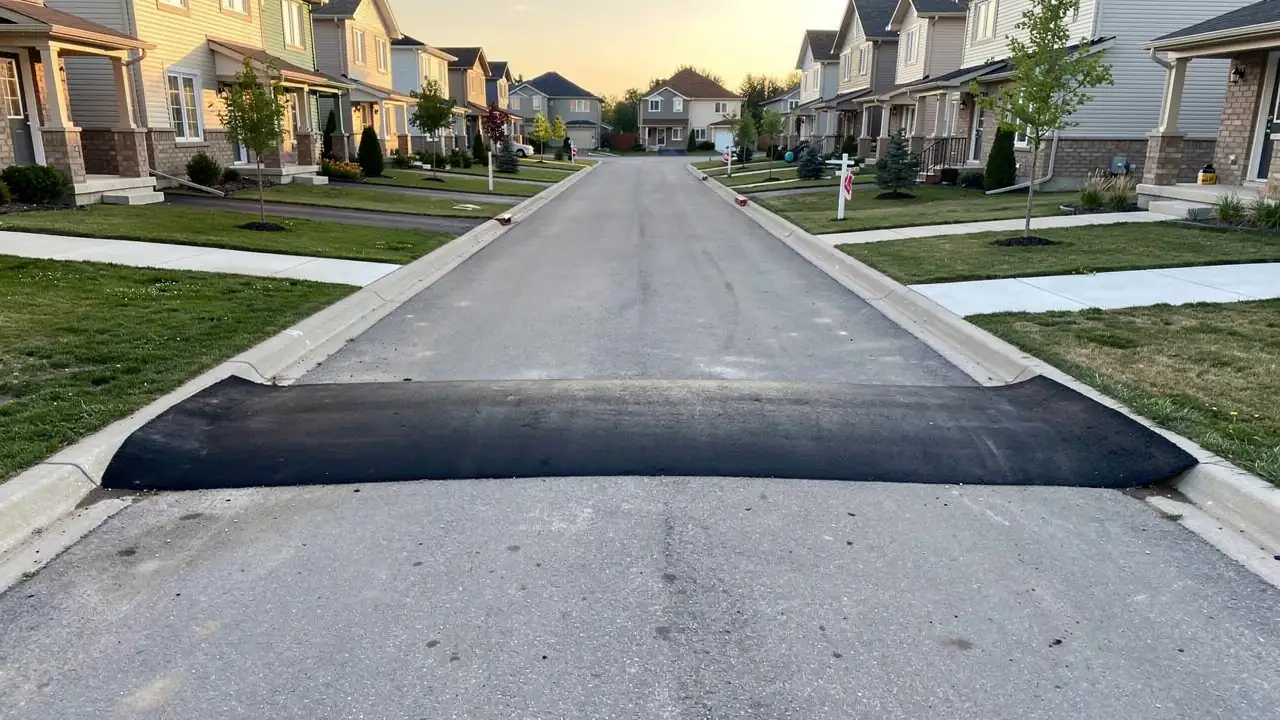
Private-property traffic calming
Kitchener Asphalt Paving Pros builds asphalt speed bumps, speed humps and speed tables on private property: plaza lots, condo roads, apartment lots, schools, churches and industrial yards. Each one is shaped from hot mix asphalt and bonded to the pavement, so there is nothing to pull loose.
Property managers and condo boards usually call us after a near miss or a run of complaints about cut-through drivers. The answer is rarely one bump; it is the right profile at the right spacing, with gaps for water and a clear path for fire trucks.
We have paved commercial lots and private roads since 2013, and every spring we see what Waterloo Region winters do to bolt-down rubber bumps. That experience shapes how we build and where we place ours.
What we do
All of our traffic-calming work is on private property, from one bump at a plaza exit to a series of humps along a condo road. We build them across Kitchener, Waterloo, Cambridge and Guelph, and also reshape or remove bumps that no longer suit the site.
Bumps for slow areas such as lot aisles and drive-thru exits, humps for private roads, and tables at crosswalks. Each is laid on existing asphalt or keyed into it, during paving or as a separate visit.
Bumps built too tall or too steep scrape low cars and jolt delivery trucks. We mill them down and rebuild the profile so drivers still slow down without the complaints.
Bumps that block drainage, a new fire route or a changed traffic pattern are milled out and the area patched flush. Our asphalt patching crews blend the repair into the surrounding lot.
Choosing a profile
Use a speed bump where cars should crawl, a speed hump where they should keep moving at a calm pace, and a speed table where people cross. The difference is mostly length: the longer the profile, the higher the speed a driver can cross it comfortably.
| Type | Typical height | Length in direction of travel | Speed it targets | Best use |
|---|---|---|---|---|
| Speed bump | 75 to 100 mm (3 to 4 in) | 300 to 900 mm (1 to 3 ft) | About 5 to 10 km/h | Parking lot aisles, drive-thru exits, loading areas |
| Speed hump | 75 to 100 mm (3 to 4 in) | About 3.7 to 4 m (12 to 13 ft) | About 25 to 30 km/h | Condo and private roads, long drive lanes |
| Speed table | 75 to 100 mm (3 to 4 in) | About 6 to 7 m (20 to 23 ft), flat top | About 30 to 40 km/h | Pedestrian crossings, school drop-off areas |
These are typical dimensions from Canadian traffic-calming practice. We confirm the exact profile at the site walk, because the right height depends on your lowest and heaviest regular vehicles, such as a garbage truck, a school bus or a low sports car.
Built for plows
Poured asphalt bumps survive plowing because they have no edge for a blade to catch and nothing to pull out. Bolt-down rubber and plastic bumps sit proud of the surface on lag bolts, and a plow hitting one at speed rips it off and leaves the anchor holes behind.
Those holes fill with water, freeze and become potholes by March. Many lots end up storing their bumps behind the dumpster every winter, which means no traffic calming for five months of the year.
An asphalt bump is tapered at both ends and along its face, so a plow blade rides up and over it. It is bonded to the pavement with tack coat, moves with the lot through freeze-thaw cycles and is sealcoated along with the rest of the surface.
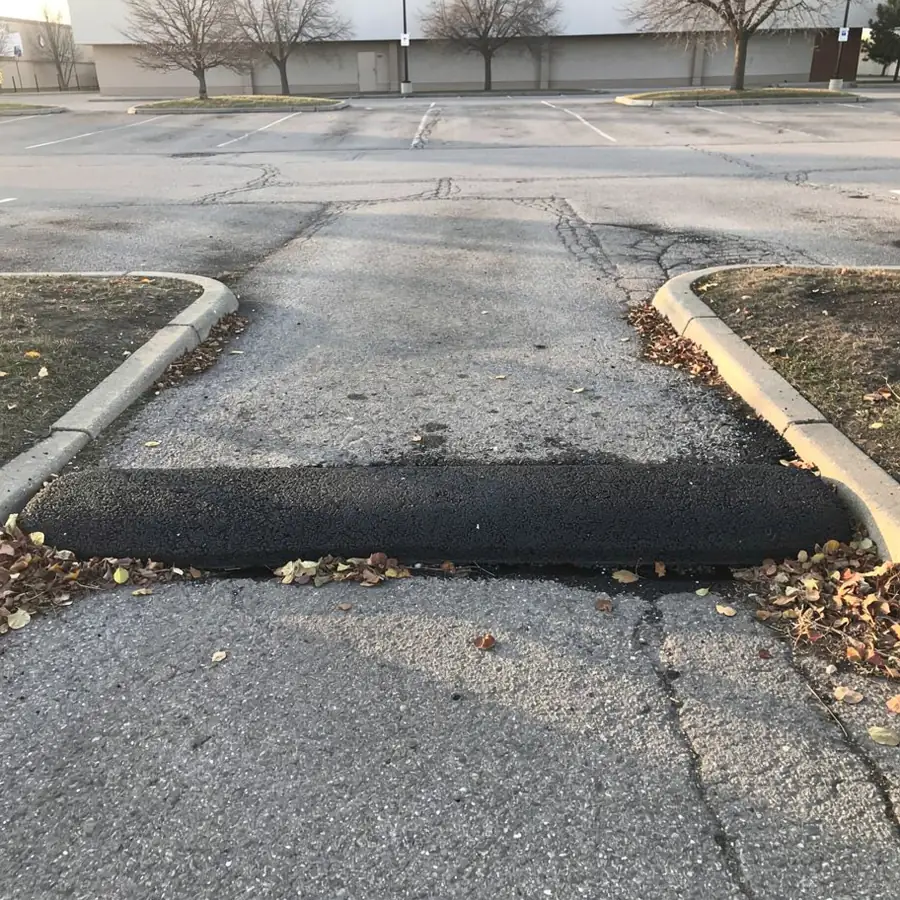
Our process
Each bump takes six steps, and most single bumps are built and cooled within one visit. The shaping step is where a smooth hump and a jarring lump part ways.
We mark each bump's position, length and drainage gaps on the pavement, and check sightlines so drivers see it in time to slow down.
The strip is swept and blown clean, and older asphalt may be milled to cut a shallow key. SS-1 tack coat goes down so the new mix bonds to the old surface.
Hot mix is placed by hand at about 135 C to 160 C and spread slightly above final height to allow for compaction.
A template cut to the chosen profile is pulled across the mix to set the height and the taper on both faces. Ends are feathered down to the pavement so tires and blades slide on smoothly.
A vibratory plate compactor and roller compact the bump while it is still hot, with the edges tamped tight to the pavement so water cannot get underneath.
Traffic can cross once the bump has cooled and firmed up. We do not do line painting, so yellow markings are applied by the line painting contractor you use or one we coordinate with, and warning signs come from your sign supplier.
Public roads
We cannot install speed bumps or humps on public streets, and neither can any other private contractor. Residential streets belong to the city or township, and traffic calming there goes through the municipality's own review.
In Kitchener, residents raise speeding concerns with the City, which reviews traffic volumes and speeds before deciding on any measures. Waterloo, Cambridge and Guelph run their own processes, and Regional roads such as Fischer-Hallman Road fall to the Region of Waterloo.
If your street is owned by a condo corporation or is a private road shared by several owners, it is private property and we can help. Check your property title or condo declaration if you are not sure who owns it.
Pricing
An asphalt speed bump typically costs $600 to $1,500, and a longer speed hump $1,500 to $3,500, before HST. Speed tables are priced per site because their length and width vary so much.
| Factor | Why it changes the price |
|---|---|
| Number of bumps | Setup and hot-mix delivery are shared, so three bumps cost less each than one |
| Road or aisle width | Wider crossings need more mix and more hand shaping |
| Profile type | Humps and tables use several times the mix of a short bump |
| Surface prep | Cracked or oxidized asphalt may need patching or a milled key first |
| Placed on top or keyed in | Keying into older asphalt adds milling but gives a stronger bond |
| Timing with other work | Bumps added during paving or repairs avoid a separate trip |
Many owners add bumps when they resurface through our parking lot paving service or rebuild a private road or laneway, which shares the trucking. Traffic calming for a whole property is often planned with a commercial paving program.
FAQ
These are the questions condo boards and property managers ask most often about speed bumps.
No. Public streets belong to the municipality, so traffic calming there goes through the city's own review; in Kitchener, start by raising the concern with the City of Kitchener. We build only on private property, including condo roads and private lanes.
Not when it is properly tapered. The gentle slopes let a blade ride over, and telling your plow contractor where each bump sits, with fibreglass markers at the ends, prevents hard hits.
Yes. We mill it down, then either patch the area flush or rebuild a lower, gentler profile, which is common where bumps were built too tall and scrape cars.
No, we do not do line painting. Yellow markings on new bumps are applied by the line painting contractor you already use, or one we coordinate with once the asphalt has cooled.
Site walk
Book a site walk and we will mark proposed locations, profiles and drainage gaps on your site plan, then price each one. Call 548-457-2043 seven days a week, or send your plan with the problem spots circled.