Full Driveway Snowmelt
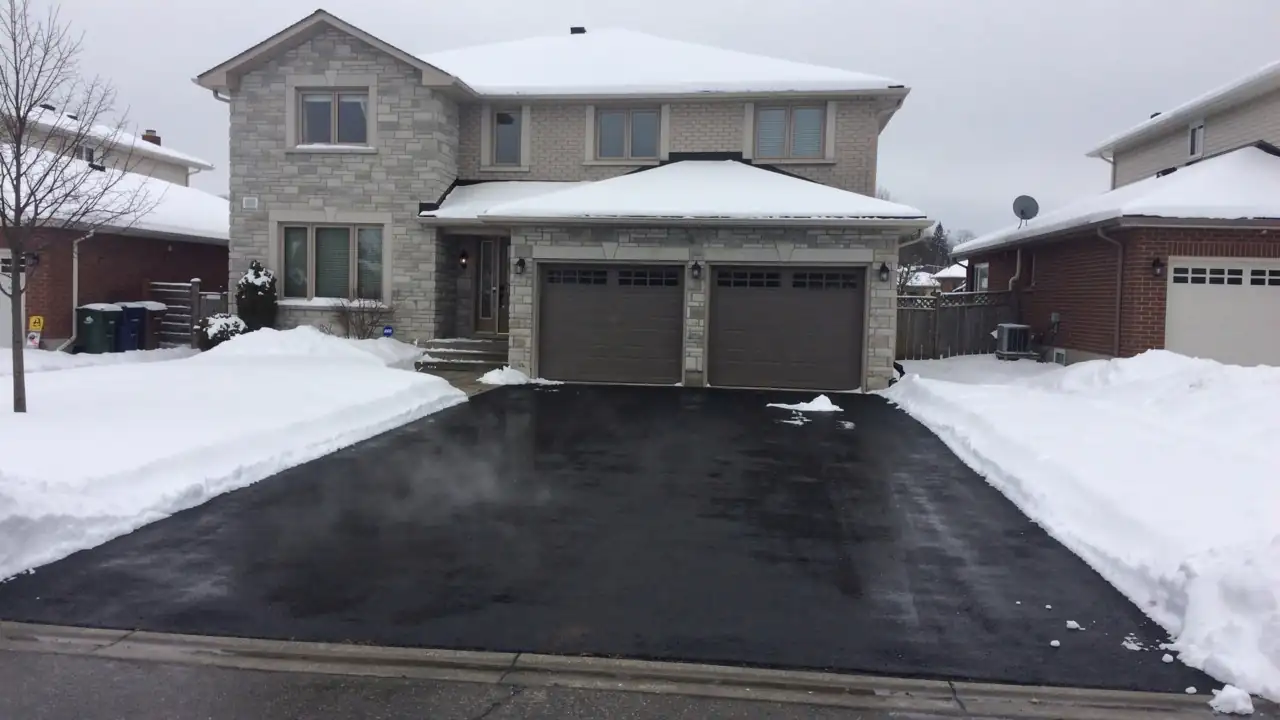
Heat under every square foot, from the garage door to the sidewalk. Best for steep or north-facing driveways where ice forms first and leaves last.
Electric and hydronic snowmelt
Kitchener Asphalt Paving Pros builds heated asphalt driveways, walkways and tire tracks with electric or hydronic snowmelt set into the base before paving. We have paved across Waterloo Region since 2013 and run the whole job, coordinating the licensed electrical contractor or TSSA-registered gas contractor who connects the heat.
Heated asphalt suits steep driveways that glaze over, homes where someone relies on a wheelchair or walker, and owners finished with plow contracts and salt damage. It goes in only with a new driveway or a replacement, because the heating sits under the asphalt.
This page compares the two systems, explains why heating changes how a driveway is paved, and gives realistic install costs for Kitchener homes.
What we heat
You can heat the whole driveway or only the parts you walk and drive on. These are the four layouts to choose from.
Heat under every square foot, from the garage door to the sidewalk. Best for steep or north-facing driveways where ice forms first and leaves last.
Two heated strips in the wheel paths, with unheated asphalt between and beside them. It cuts the heated area, and the cost, by well over half on a typical double driveway.
A heated path from the driveway to the front door, built with our asphalt walkways and ramps. We stop at the bottom step; heated steps are a concrete or masonry job.
If your old driveway is failing anyway, the tear-out is the moment to add heat. Our driveway removal and replacement crew builds the new base for it.
Compare systems
Electric systems cost less to install and suit smaller areas, while hydronic systems cost more up front but are often cheaper to run over a large driveway. The table sets them side by side, and the notes below explain each part.
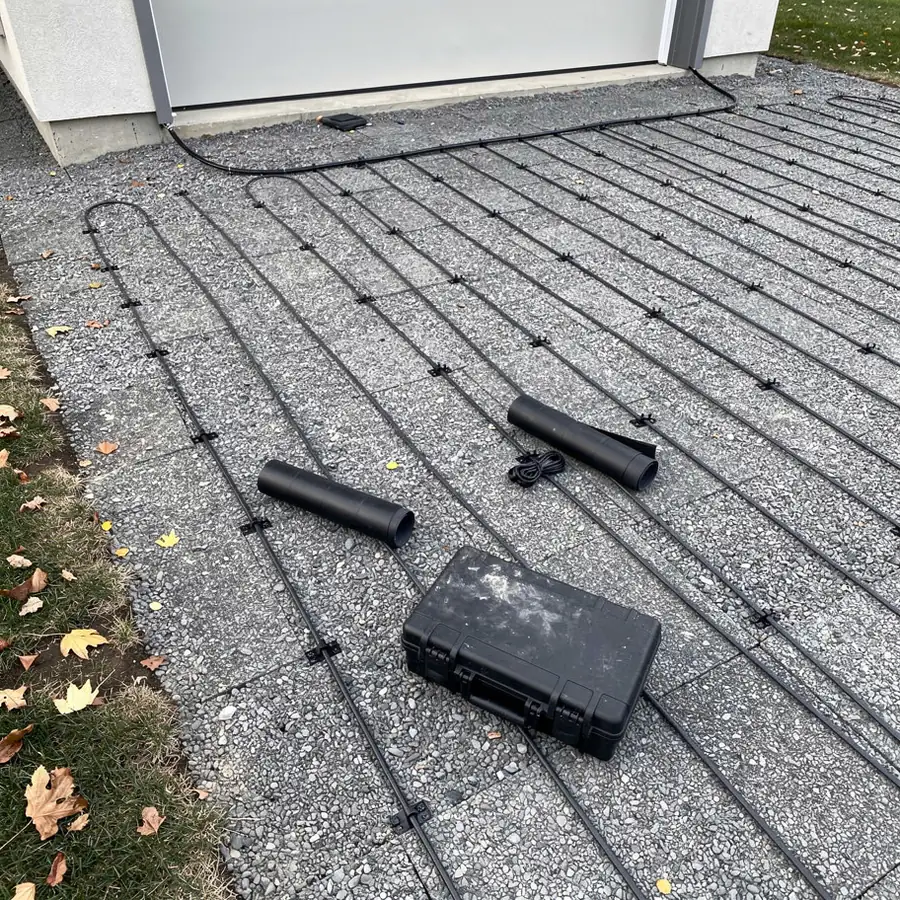
We use self-regulating or mineral-insulated heating cable that its maker rates for hot asphalt placement, laid loose or pre-spaced on mats. Standard indoor floor-heating cable melts or cracks under hot mix and is never used.
The cable runs on a dedicated, ground-fault protected circuit wired by a licensed electrical contractor.
Loops of PEX tubing carry a heated glycol and water mix that will not freeze. The loops return to a manifold in the garage or basement, fed by a dedicated boiler or a heat exchanger on the house system.
The mechanical room work, which includes the boiler, pumps and controls, is where the $6,000 to $12,000 goes.
Cost and power both scale with heated area. On a 30 ft driveway, two 2 ft tire tracks are about 120 heated sq ft, against roughly 800 sq ft for a full double driveway.
Tracks keep the car moving, but snow still sits beside them, so tracks pair well with a heated walk to the door.
| Feature | Electric | Hydronic |
|---|---|---|
| Heat source | Heating cable or mats on a dedicated circuit | Gas boiler heating a glycol mix through PEX tubing |
| Install cost | $18 to $30 per heated sq ft, plus electrical work | $20 to $35 per heated sq ft, plus $6,000 to $12,000 for the boiler and mechanical room |
| Running cost | Electricity by the hour; overnight rate plans help | Natural gas; often lower per hour on large areas |
| Response time | Heats as soon as it switches on | Slower to start; often idled ahead of a storm |
| Maintenance | No routine service | Yearly boiler service and glycol checks |
| Best fit | Tire tracks, walkways and single driveways | Large or full double driveways with room for a boiler |
The hard part
Hot mix arrives at about 135 C to 160 C and a vibratory roller follows it, so the heating has to survive both heat and crushing weight. Concrete snowmelt systems are poured cool; asphalt systems are not, and that changes every step.
This is how we protect the system through paving:
The common failure is a cable nicked by a rake or crushed under a dropped load. Caught on the test meter before the asphalt is rolled, it is a quick splice; found after, it means cutting out new asphalt.
Our process
Designs are best done in winter and installs happen in the paving season, late April to mid-November. Layout and testing add time on site, and we build it into the paving schedule.
We map the heated zones, cable or loop spacing and where the leads or lines enter the house, then price both systems if either could work.
The electrical contractor checks whether your panel and service can carry a snowmelt circuit, or the gas contractor checks boiler and gas line capacity.
A licensed electrical contractor files the notification with the Electrical Safety Authority. A TSSA-registered gas contractor installs any boiler; we schedule both.
The base is built to our standard driveway spec, compacted Granular A on a firm subgrade, and graded so meltwater drains to the street.
Cable or tubing is fixed to the layout, bedded and tested. Readings are written down so the after-paving test has a baseline.
The surface is laid and rolled with the system protected, then every circuit or loop is tested again before the crew leaves.
Once the trades connect the power or boiler, the sensor and controls are set up and you are shown how to run them before the first snowfall.
Pricing
A heated driveway in Kitchener costs $18 to $30 per heated sq ft for electric and $20 to $35 per heated sq ft for hydronic, on top of the paving. Hydronic adds $6,000 to $12,000 for the boiler and mechanical room, and electrical work is priced separately by the electrician.
| Heated area | Electric | Hydronic, before boiler |
|---|---|---|
| Two tire tracks, about 120 sq ft | $2,160 to $3,600 | $2,400 to $4,200 |
| Front walkway, about 100 sq ft | $1,800 to $3,000 | $2,000 to $3,500 |
| Full double driveway, about 800 sq ft | $14,400 to $24,000 | $16,000 to $28,000 |
Paving is quoted on top, at the usual replacement price of $5.50 to $8.50 per sq ft for a peel and pave. A panel upgrade, if the electrician finds one is needed, is the most common surprise cost on electric systems.
FAQ
These are the questions homeowners ask most on a heated driveway consult.
No. The cable or tubing sits under the asphalt, so heat goes in only when the driveway is built new or fully replaced, through our asphalt removal and replacement service.
The electrical work does: a licensed electrical contractor must file a notification with the Electrical Safety Authority, and gas boiler work must be done by a TSSA-registered contractor. If you also widen the driveway onto the boulevard, the City widening permit applies as usual.
Heating cable has no moving parts, so a cable that passes its insulation test after paving is set up for a long service life. Warranty terms vary by manufacturer and product, and we give you the warranty, the layout drawing and the test readings with your paperwork.
Yes, but more slowly. Every system has a set output, so in deep cold with heavy snow it melts at a slower rate and snow can build up briefly before it clears. Sensors that start at the first flake, and an idle setting before storms, close most of that gap.
Free design consult
Heated driveway searches peak in January, but installs happen from spring to fall, so winter is the right time to design one. Book a consult now and we will have the layout, trades and price ready before the spring paving calendar fills in Kitchener, Waterloo and Guelph.