Property Managers and Condo Boards
Condo roads and visitor lots collect small failures at catch basins, speed bumps and corners. One visit can fix many of them, with each area reopened within the hour.
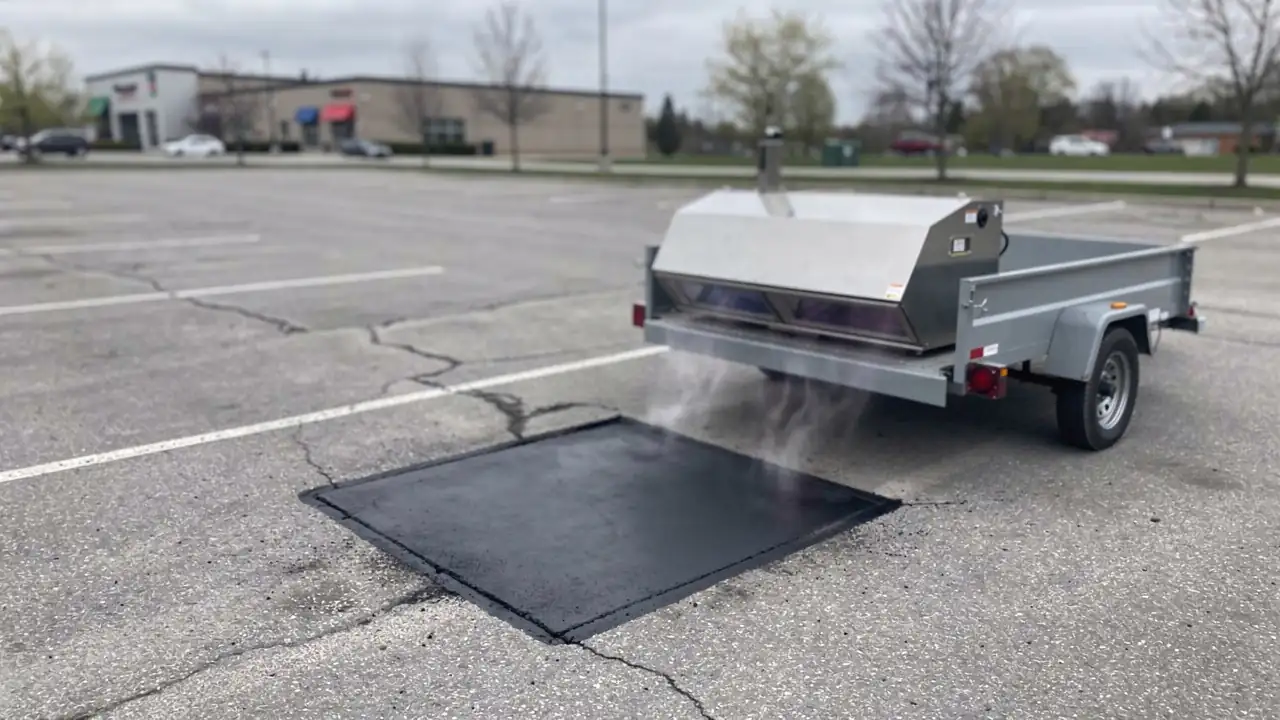
Seamless, watertight patches
Kitchener Asphalt Paving Pros offers infrared asphalt repair, a patching method that heats damaged pavement until it is workable and blends fresh hot mix into it. The repair bonds with the asphalt around it, so there is no cut edge for water to get into.
It suits property managers, condo boards, plaza owners and homeowners with isolated damage on otherwise sound pavement: a pothole, a sunken ring around a catch basin, a low spot that holds water or a raised lip at an old utility cut. Few contractors in the Kitchener market run infrared equipment, and at about 30 to 60 minutes per area it is one of the fastest repairs we do.
Across 14 seasons and more than 2,500 jobs, we use infrared where it beats a saw-cut patch and say so plainly where it does not. A failed base cannot be fixed from the surface, whatever the heater.
Who it is for
Infrared repair fixes isolated surface damage quickly and without seams, so it fits properties where traffic cannot be stopped for long. We run it from our Kitchener shop to Cambridge plazas and business parks along Hespeler Road and the Highway 401 corridor, and to Guelph commercial lots in the Hanlon business park.
Condo roads and visitor lots collect small failures at catch basins, speed bumps and corners. One visit can fix many of them, with each area reopened within the hour.
Drive-throughs, entrances and fire routes cannot close for a day of sawing and digging. Infrared repairs keep each closure to one small coned area at a time.
A single pothole near the garage or a sunken spot over an old trench is a good fit when the rest of the driveway is sound. The repair blends in and leaves no seam to crack.
The method
Infrared repair reheats the existing asphalt instead of cutting it out, then reworks it with new material into one continuous surface. Each area takes about 30 to 60 minutes from start to reopening.
Water, loose stone and debris are blown out of the damaged spot so the heater works on asphalt, not puddles.
A radiant infrared panel covering an area up to about 1.8 m by 1.8 m (6 ft by 6 ft) is lowered over the damage. It softens roughly the top 40 to 50 mm (1.5 to 2 in) gradually, without burning the binder.
The softened asphalt is raked and scarified so the old material can be reworked and mixed with new.
A rejuvenating emulsion is sprayed on the hot material to restore oils lost to years of oxidation, so the old asphalt becomes flexible again.
New hot mix from the hot box fills low spots and replaces stone that was lost, bringing the area level with the surface around it.
A vibratory roller or plate compacts the area, with the edges feathered into the heated surrounding asphalt so the old and new fuse.
Once the repair cools, usually within an hour, traffic can use it.
Infrared vs saw-cut
A saw-cut patch leaves a cold joint on all four sides, where hot mix meets cold asphalt, and water finds those joints first. An infrared repair is heated into the pavement around it, so there is no joint to open.
That does not make infrared better for every job. The table shows where each method wins.
| Factor | Infrared repair | Saw-cut patch |
|---|---|---|
| Seams | None; heat-bonded to the surrounding asphalt | Cold joints on every side, sealed to keep water out |
| Time per area | About 30 to 60 minutes | Several hours with sawing, digging and base work |
| Fixes the base? | No; works on the top 40 to 50 mm | Yes; soft base is dug out and rebuilt |
| Residential cost | $450 to $900 for the first area | $350 minimum; $8 to $15 per sq ft for small patches |
| Commercial cost | Day rate $2,500 to $4,000 | $6 to $12 per sq ft, full depth |
| Best use | Surface damage on a sound base, catch basins, low spots | Potholes over soft base, deep failures, larger areas |
When we find wet clay or missing stone under the damage, we recommend saw-cut asphalt patching instead, because only digging out the base fixes it.
Good fits
Infrared works best on damage that is shallow, isolated and sitting on firm ground. These are the four situations we see most, including the one where we turn the job down.
Isolated potholes and patches of loose, ravelled stone on a sound base are reheated, rejuvenated and topped up. The finished area reads as part of the pavement, not a patch on top of it.
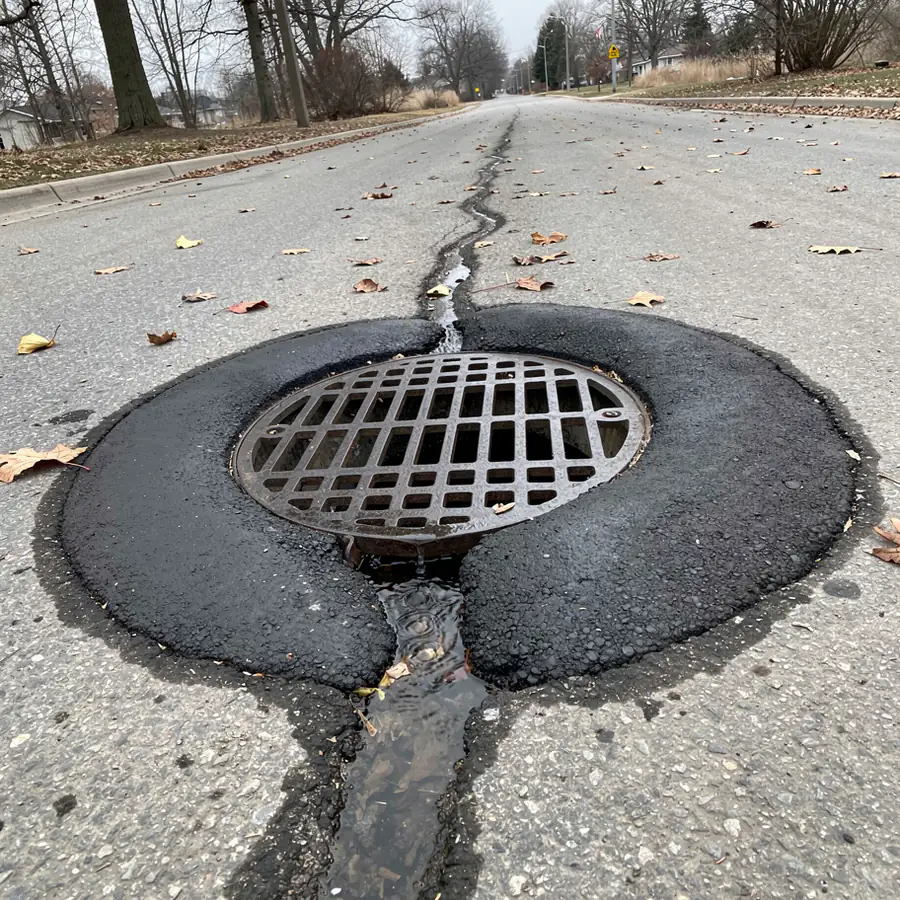
Asphalt around catch basins often settles into a dish or rises above the grate. We reheat the ring and reshape it so water flows into the basin instead of pooling around it.
Low spots that hold water, raised lips at old patches and the open seams of utility trenches are heated and levelled. The trench seam disappears, which stops it from becoming a crack line.
Large alligator-cracked areas, soft or wet base and deep ruts need full-depth repair. If damage is spread across the whole surface, asphalt removal and replacement or an overlay is better value.
Season and weather
Infrared heating works on cold pavement, because the heater brings the asphalt up to working temperature itself; what it needs is a dry, snow-free surface. The insulated hot box keeps fresh mix workable for hours, so one load from the plant can serve a full day of scattered repairs.
That gives infrared a longer repair season than conventional patching.
When plants start running reduced hours and patch crews wind down, a hot box of mix still covers a lot full of repairs in one trip.
Hot mix plants usually close in December. On dry days, some repairs can still be done by reheating and rejuvenating the existing asphalt, and we confirm what is possible when you call.
Temporary cold patch placed over the winter is removed and the area repaired properly as soon as the surface is dry.
Pricing
Residential infrared repair costs $450 to $900 before HST for the first area, up to about 1.8 m by 1.8 m (6 ft by 6 ft). Commercial infrared work is usually priced as a day rate of $2,500 to $4,000.
For property managers, the day rate usually works best: we fix as many marked areas as a day allows, highest-risk first. Many owners pair it with our crack filling and sealing on the same visit.
FAQ
These are the questions owners ask most before booking infrared work.
On a sound base, an infrared repair usually lasts as long as the asphalt around it, because it is bonded into that asphalt rather than sitting beside it. On a soft or wet base it will fail like any surface repair, which is why we check the base first.
Usually within an hour. Once the compacted area has cooled, cars and trucks can drive on it, so each repair area only needs to be coned off briefly.
It works in panel-sized sections of up to about 1.8 m by 1.8 m, overlapped for bigger areas. Past a handful of sections in one place, asphalt resurfacing is usually better value.
Yes, when the driveway is sound and the damage is one or two isolated spots. At $450 to $900 for the first area, it costs more than a small saw-cut patch but leaves no seam to crack or let water in.
Lot walk-through
Property managers can book a lot walk-through: we mark every repair area, tell you which ones suit infrared and which need a full-depth patch, and price them per area or by day rate. Homeowners can send a photo of the damage for a first opinion before the site visit.