Residential Driveway Sealing
A typical double driveway is cleaned, crack filled, edged and sealed in one visit. You can walk on it the same evening and drive on it after 24 to 48 hours.
Coal-tar-free sealers only
Kitchener Asphalt Paving Pros seals residential driveways and sealcoats commercial parking lots with coal-tar-free asphalt sealers, choosing a water-based emulsion or an oil-based sealer to suit each surface. Every job includes cleaning, crack filling and hand-cut edges before any sealer goes down.
Homeowners book driveway sealing every 2 to 3 years to keep the surface black and shed salt and oil. Plaza owners, condo corporations and industrial sites book asphalt sealcoating as part of a maintenance cycle, done in sections so tenants and residents can still park.
We have sealed asphalt across Waterloo Region since 2013, and the jobs that peel early almost always share one of three causes: sealer laid on dirty asphalt, on damp asphalt or on asphalt that had not cured. Our process is built to rule out all three.
Our services
We seal driveways, plaza and condo lots, church and office lots and industrial yards, as one-off visits or on a set cycle. Every visit includes the same preparation, because sealer is only as good as the surface under it.
A typical double driveway is cleaned, crack filled, edged and sealed in one visit. You can walk on it the same evening and drive on it after 24 to 48 hours.
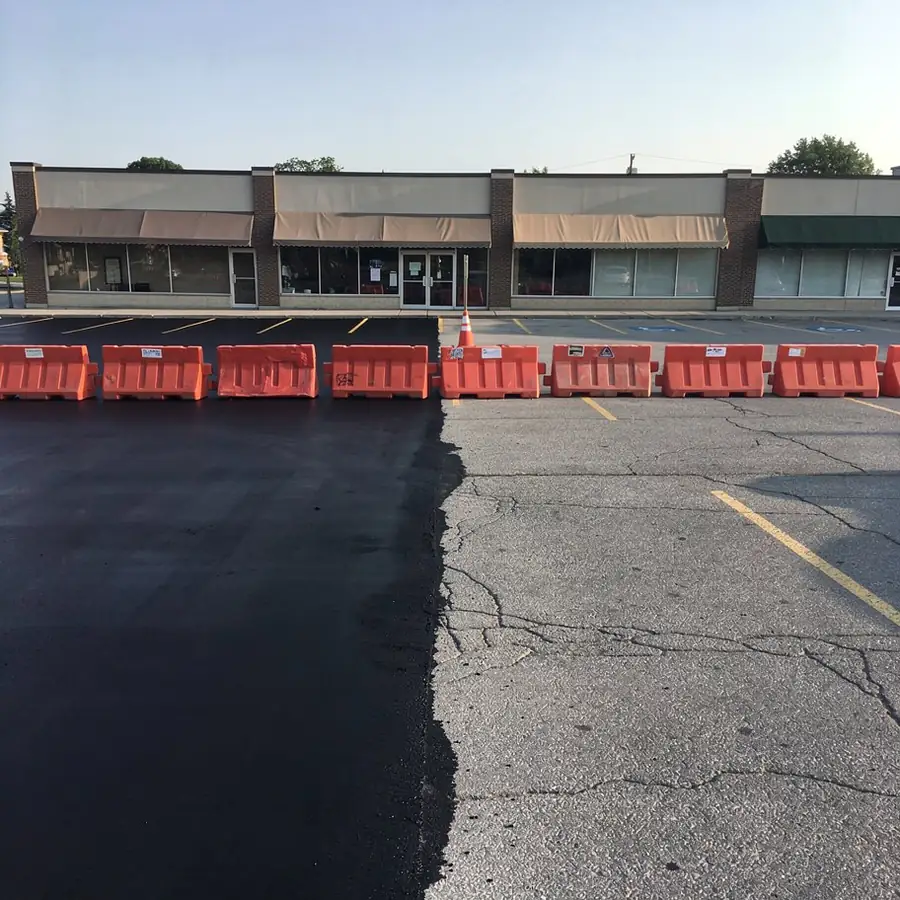
Plazas, condos and offices are sealed in sections with barricades, so part of the lot stays open while the rest cures. We coordinate a line painting contractor to restripe right after.
Property managers can set sealing on a 2 to 3 year cycle alongside crack sealing and patching, priced and scheduled ahead through our asphalt repair and maintenance plans.
Honest expectations
Sealcoating protects the surface of sound asphalt from sun, water, salt and spills, and restores its black colour. It does not repair anything, so damage has to be fixed before the sealer goes on.
A thin coat of sealer shields the binder that holds the stone together. These are the benefits you can expect.
Sealer is a protective film a fraction of a millimetre thick, not a structural layer. These problems need a repair first.
If your surface has potholes or alligator cracking, start with asphalt patching and pothole repair and seal once the patches have weathered.
Sealer types
Oil-based sealers soak into older, dry asphalt and leave a deeper black; water-based emulsion sealers form a protective layer on top, dry faster and smell far less. Both types we use are coal-tar-free asphalt sealers.
We recommend one or the other after looking at the age, porosity and use of your surface.
Oil-based sealer penetrates older asphalt that has lost its oils, which helps a dry, open surface hold together a little longer. The trade-off is a longer cure and a solvent smell that some homeowners notice near open garage doors and windows.
Water-based sealer sits on top as a protective layer and dries faster with very little odour. It needs a warm, dry day to cure properly, so we schedule it for sunny weather and avoid cool, humid evenings.
| Property | Oil-based sealer | Water-based emulsion sealer |
|---|---|---|
| How it works | Solvent carries asphalt into the surface and re-oils dry binder | Asphalt emulsion dries into a film on the surface |
| Finish | Deeper, richer black | Even black with a flatter sheen |
| Walk-on time | Toward the long end of 4 to 8 hours | Toward the short end of 4 to 8 hours |
| Drive-on time | Usually closer to 48 hours | Often 24 hours in warm sun |
| Odour | Strong solvent smell for a day or so | Low odour |
| Weather sensitivity | Needs 10 C and rising and dry pavement | Needs 10 C and rising, plus sun and low humidity to dry |
| Best use | Older, grey, porous driveways | Newer driveways, commercial lots and well-kept surfaces |
Application
On driveways we cut in every edge by hand with a brush and spread the rest with a squeegee, which works the sealer into the surface texture. On large lots we hand-edge first and then spray, because spraying lays thin, even coats quickly over a big area.
Each method has a job it does best.
A brush pushes sealer into pores and around edges, garage aprons and walkways. It is slow but gives the cleanest lines, so every job starts with it.
A rubber squeegee drives sealer into open, older asphalt and fills fine texture. It suits driveways and porous surfaces that need more material.
Spray equipment applies a uniform thin coat fast and suits commercial lots. Two thin sprayed coats outlast one heavy one, which can stay soft and track.
Our process
A typical driveway is sealed in one visit, and a commercial lot over one or more days by section. The order of these six steps never changes.
Dirt, sand, leaves and loose stone are blown and swept off; grimy or stained surfaces are washed with hot water and left to dry completely.
Oil and fuel stains get a primer that seals them in, so they do not lift or discolour the new coat.
Cracks are filled or sealed with hot-pour rubberized sealant before any sealer is spread.
We brush a clean border along garage slabs, walkways, curbs and lawn edges, and mask anything that must stay clean.
One coat suits most driveways in good shape. Older, porous surfaces and busy lots get two thin coats, with drying time between them.
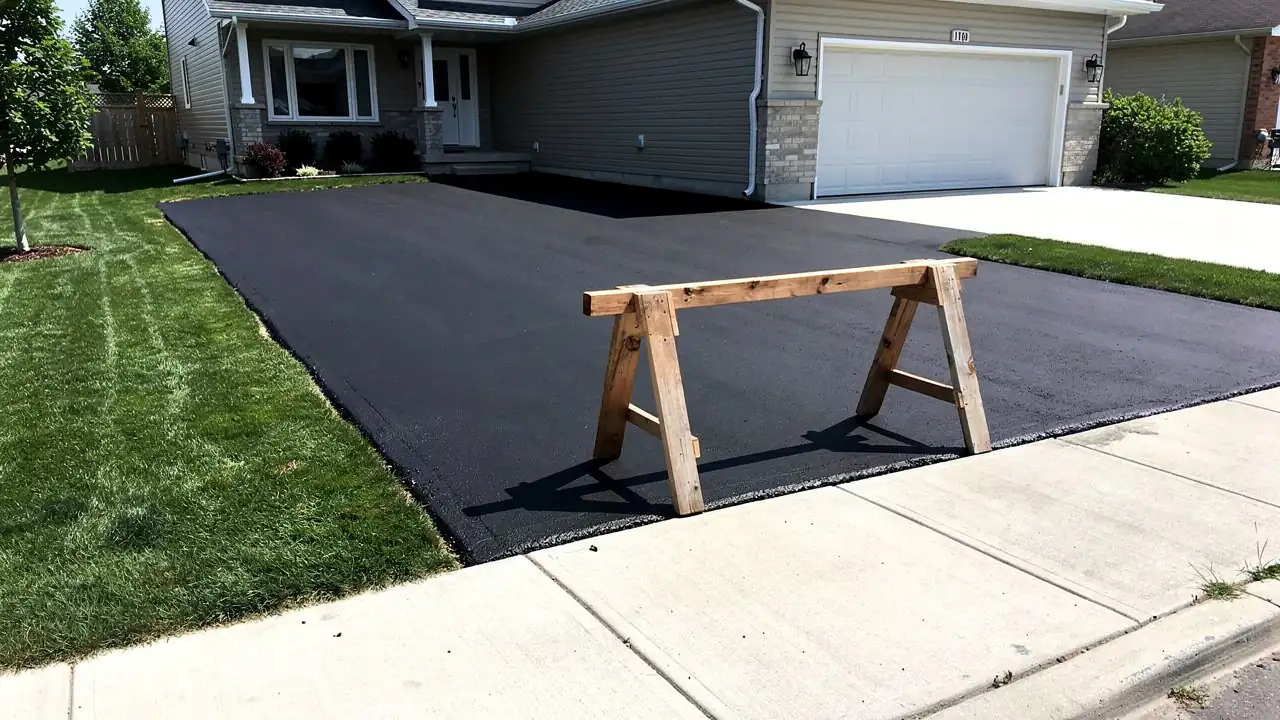
Sawhorses or cones go across the entrance and stay until the sealer is ready for foot and then vehicle traffic.
Drying times
You can walk on a sealed driveway after 4 to 8 hours and drive on it after 24 to 48 hours. Sealing needs air at 10 C and rising, dry pavement and no rain for the following 24 hours.
| Condition | Effect on drying |
|---|---|
| Full sun, 20 C or warmer | Fastest; walk-on near 4 hours |
| Shade from trees or the house | Slower; shaded sections can stay tacky for hours longer |
| High humidity or heavy dew | Slows water-based sealer the most |
| Cool evening after an afternoon job | Can push drive-on time toward 48 hours |
| Rain within 24 hours | Can wash off uncured sealer; we reschedule |
Keep lawn sprinklers off the driveway for a day, and in hot weather avoid turning the steering wheel while the car is stopped on fresh sealer. We watch the forecast closely and move a booking rather than seal ahead of rain.
Pricing
Residential driveway sealing costs $0.25 to $0.45 per square foot before HST, with a $250 minimum, and a typical double driveway runs $250 to $450. Commercial sealcoating runs $0.18 to $0.30 per square foot, depending on the size of the lot.
Price depends on area, how porous the surface is, the number of coats, and how much crack filling and oil-spot priming the surface needs first.
We seal across Waterloo Region and Wellington County, including driveway sealing in Waterloo, driveway sealing in Cambridge and driveway sealing in Guelph, all within about 15 to 35 minutes of our Kitchener shop.
FAQ
These are the driveway sealing questions homeowners and property managers ask us most.
Usually 24 to 48 hours. Shade, humidity and a cool evening slow drying, so a shaded driveway sealed late in the day sits at the longer end.
No. New asphalt should cure for about 12 months, so a driveway paved this summer is first sealed next season. Sealing sooner traps oils still leaving the surface and can leave it soft enough to scuff.
The sealer that lasts is the one applied well, more than any brand. What matters is solids content, a clean and dry surface, thin even coats rather than one heavy one, and enough warm days to cure before cold nights arrive in late September.
Yes, if the asphalt is sound. At $250 to $450 for a typical double driveway every 2 to 3 years, sealing slows the oxidation and salt damage that shorten a 15 to 25 year driveway life; on a failing driveway, the money is better spent on repair or replacement.
Yes. We phase lots by section and can schedule early mornings, evenings or Sundays so a plaza or condo can keep operating while the work is done.
Book early
Driveway sealing demand peaks from June to August, so booking in April or May gets you the dry, warm date you want. Tell us your driveway or lot size and we will quote the sealer type, coats and prep in writing.