Asphalt paving FAQ
Asphalt Paving Questions From Kitchener and Waterloo Region Property Owners
Kitchener Asphalt Paving Pros answers these questions on site visits across Waterloo Region every season, and after more than 2,500 jobs since 2013 the same ones come up again and again. Each answer gives the short version first, then links to the service page that covers it in depth.
Questions are grouped by topic: cost, build quality, timing and curing, sealing and maintenance, permits, trust and warranty, and commercial properties. If yours is not here, call or email and we will answer it directly.
Cost
Cost and Quotes
Cost is the first question on almost every call. Prices below are typical ranges before HST, and your written quote replaces them once we have seen the site.
How much does an asphalt driveway cost in Kitchener?
Most asphalt driveways in Kitchener cost $4.00 to $11.00 per square foot before HST, and the base work decides where yours lands in that range. The four install types are priced as follows, and our asphalt driveway paving page explains which one fits which driveway.
- Grade and pave over sound gravel: $4.00 to $6.50 per sq ft
- Removal and replacement: $5.50 to $8.50 per sq ft
- Full excavation and rebuild: $7.00 to $11.00 per sq ft
- Overlay on a sound driveway: $3.00 to $4.50 per sq ft
How much does a 20 x 20 or 1,000 sq ft driveway cost?
A single driveway of 400 to 500 sq ft, which includes a 20 x 20, typically costs $2,800 to $4,500 for removal and replacement. A double driveway of 800 to 1,000 sq ft usually runs $4,800 to $8,000.
Grade and pave jobs over gravel can come in lower, but our minimum paving job is $2,500. Full rebuilds cost more because of the digging and new stone, as our driveway removal and replacement page explains.
Is asphalt cheaper than concrete?
Yes, an asphalt driveway usually costs less to install than poured concrete, and it is faster and cheaper to repair when a section fails. Asphalt also flexes slightly through freeze-thaw and does not scale from road salt the way concrete surfaces can.
We pave asphalt only. If you want concrete steps or a pad beside a new asphalt driveway, we coordinate with a concrete contractor.
Are your quotes free and in writing?
Yes, every quote is free, written and itemized. We visit within 2 to 3 business days of your request and send the quote within 2 business days of the visit.
Ontario requires home renovation contracts over $50 to be in writing, and ours list area, base depth, thickness, mix, drainage, start window, payment terms and warranty. You can request a free paving quote online.
Why do paving quotes vary so much?
Quotes vary because they often describe different jobs: one may include full removal and 200 mm of new base, another a thin layer over the old surface. The main price drivers are size, removal and disposal, base condition, excavation depth, truck access, thickness and lifts, drainage work, permits, hand work around steps and walls, and the season.
Our guide to comparing paving quotes and vetting contractors shows what to check line by line.
Build quality
Build Quality and Materials
Few paving companies publish their build specs. These answers give ours, and the full table by job type is on our about page with our build standard.
How thick should an asphalt driveway be? Is 2 inches enough?
Two inches (50 mm) of compacted HL3 is the minimum for cars on a sound base, and we lay 60 mm (2.5 in) as standard. Driveways where an RV, work truck or trailer parks get two lifts, 50 mm of HL8 under 40 mm of HL3, on a deeper 200 to 250 mm base.
The stone under the asphalt matters more than the asphalt thickness, which is why our driveway paving quotes list both.
What base goes under your asphalt?
We use compacted Granular A, crushed stone 19 mm and down, at 150 to 200 mm (6 to 8 in) under a standard car driveway. Heavy-use driveways get 200 to 250 mm, and parking lots and private roads add 300 mm or more of Granular B as a subbase.
Over soft or wet clay, common across Kitchener, a non-woven geotextile goes down first so the stone does not sink into the soil. Our removal and replacement page covers how a failed base is rebuilt.
What is the difference between HL3 and HL8 asphalt?
HL3 is a surface mix with stone up to 13.2 mm that gives a tight, smooth finish, while HL8 is a binder mix with coarser 19 mm stone used as a strong lower layer. Car driveways get HL3 alone, while parking lots, truck lanes, garage floors and private roads get HL8 under HL3.
HL3 Fine (HL3F) is a smoother version we use as the top lift on sport courts and some walkways.
What are the downsides of recycled asphalt?
Recycled asphalt (RAP, or millings) is compacted rather than hot-laid, so it never forms the sealed, smooth surface of hot mix. Expect some loose stone, softer edges, ruts in wet spots and occasional regrading and top-ups.
It is good value for rural laneways and farm yards at $1.50 to $3.00 per sq ft, which is how we use it on private roads and laneways. For a house driveway you shovel and walk on every day, hot mix is the better choice.
How long does an asphalt driveway last?
A properly built and maintained asphalt driveway lasts 15 to 25 years in Waterloo Region. Commercial lots on an engineered base last 20 to 30 years with regular maintenance, and an overlay adds 8 to 15 years to a sound driveway.
Crack sealing and sealcoating every 2 to 3 years push a surface toward the top of those ranges.
Repair or replace
Repair, Resurface or Replace? How We Decide
The condition of the base decides whether a driveway needs a repair, a new surface or a full replacement. Age and looks matter much less than whether the stone underneath still holds its shape.
Repair when the damage is local
Isolated cracks, a pothole or a settled patch around a catch basin on otherwise firm asphalt call for asphalt repair. Crack sealing, patching or infrared repair fixes the spot for far less than repaving.
Resurface when the structure is sound
A grey, rough or lightly cracked driveway that is not sinking anywhere is a candidate for an overlay of 40 to 50 mm of new HL3. Our asphalt resurfacing page covers the milled tie-ins at the garage and street.
Replace when the base has failed
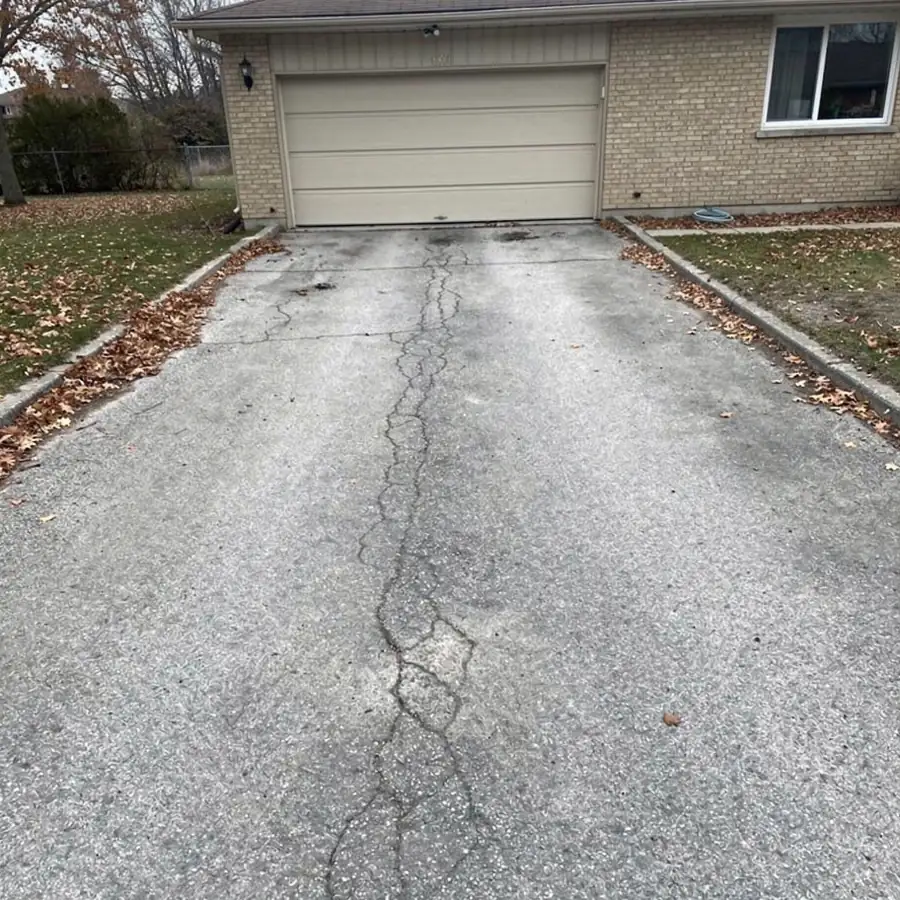
Alligator cracking, sinking, frost heave or water that pools in the same spot every spring means the base is gone. An overlay would crack along the same lines, so the old asphalt and base come out and are rebuilt.
Timing
Timing and Curing
Most driveways take a day to pave, but curing takes months. These answers cover the paving season, how long a job runs and when you can use the surface.
How long does paving a driveway take?
Removing and replacing a typical double driveway takes 1 day on site, and a full rebuild or a large driveway takes 2. An overlay takes half a day to a full day.
In season, plan on 2 to 4 weeks from signing to paving day, plus up to 5 business days for utility locates. Our driveway removal and replacement service follows that schedule.
When can I drive and park on new asphalt?
You can walk on new asphalt once it cools, a few hours after paving, and drive on it after 48 to 72 hours, longer in a heat wave. Keep trailers, RVs and heavy trucks off for 2 weeks.
Through the first summer, avoid turning the steering wheel while stopped and keep kickstands, jack stands and trailer jacks off the surface. Aftercare for each install type is on our asphalt driveway paving page.
What is the best time of year to pave in Waterloo Region?
The paving season runs from about late April to mid-November, whenever the air is at least 5 C and rising and the base is not frozen. September and October are good paving months, cool but still warm enough for hot mix.
Book between February and April for spring or summer work, since the calendar usually fills by May. Sealing has its own, shorter window, covered under asphalt sealcoating.
Can you pave in the rain or in late fall?
No, we do not pave on a wet or frozen base or in steady rain, because the hot mix cools too fast to compact properly. A light shower before the trucks arrive may only delay the start.
Most asphalt plants close for winter in December, so mid-November is the practical end of the season and later jobs move to spring.
How long does new asphalt take to fully cure?
New asphalt takes 6 to 12 months to fully cure, and it stays softer than usual through its first hot summer. That is why tire scuffs and power-steering marks can appear on a new driveway, and why the first sealcoat waits about 12 months.
Maintenance
Sealing and Maintenance
A few hundred dollars of upkeep every couple of years is what moves a driveway toward the long end of its lifespan. These answers cover sealing, cracks and small repairs.
When should I first seal a new driveway, and how often after that?
Seal a new driveway after about 12 months, in the season after it is paved, then every 2 to 3 years. Sealing sooner traps oils still leaving the fresh asphalt, and sealing every year builds up a layer that can peel.
A typical double driveway costs $250 to $450 to seal with our driveway sealcoating service.
Is sealing a driveway worth it?
Yes, for a driveway in good shape, sealing slows the oxidation that turns asphalt grey and brittle and reduces ravelling from road salt. It does not fix cracks, sinking or a failed base, so cracks are filled first.
All our sealers are coal-tar-free. Coal-tar pavement sealants are banned in Canada under SOR/2025-36, with sales ending December 31, 2025.
How long does driveway sealer take to dry?
You can walk on fresh sealer after 4 to 8 hours and drive on it after 24 to 48 hours. We only seal when it is at least 10 C and rising, the pavement is dry and no rain is expected for 24 hours.
Why does asphalt crack in Ontario winters?
Asphalt cracks in Ontario winters because water gets into small cracks, freezes, expands about 9% and pries the pavement apart. Waterloo Region swings above and below 0 C dozens of times a winter, so each crack widens a little with every cycle.
Sealing cracks in spring or fall, when they are open, stops that cycle before potholes form. See asphalt crack filling and sealing.
How do I fix big cracks in an asphalt driveway?
Cracks wider than a hairline need hot-pour rubberized crack sealant, melted in an oil-jacketed melter and applied hot so it bonds and stretches with the pavement. Cold-pour fillers only suit small hairline cracks.
Spiderweb or alligator cracking is a base problem, which calls for asphalt patching rather than crack fill.
What is infrared asphalt repair?
Infrared repair heats a damaged area until the asphalt softens, then blends it with fresh hot mix and rejuvenator so the patch has no cold seam. Each area takes 30 to 60 minutes and is usually drivable within an hour.
It suits potholes, settled spots around catch basins and raised seams; see infrared asphalt repair.
Permits
Permits and Rules
Most paving needs no permit, but widening a driveway, cutting a curb or building a new entrance usually does. These are the rules we check before quoting.
Do I need a permit to widen my driveway in Kitchener?
Yes, the City of Kitchener requires a permit to widen the driveway apron or boulevard or to cut or lower a curb. Apply at least 15 business days ahead; the permit is $400, with $249 refunded after a passed inspection, and Regional roads add $100 plus Region of Waterloo permits.
The City of Kitchener driveway widening page lists clearances from hydrants, hydro poles, community mailboxes and trees. We check the zoning width limit for your lot when we quote an asphalt driveway.
What permits apply in Waterloo, Guelph and the townships?
Each municipality has its own approval for new or widened entrances, so we confirm which authority controls your road before quoting. Local details are on our pages for driveway paving in Waterloo and driveway paving in Guelph.
- City of Waterloo: widening and new curb cuts need City approval for driveways and curb cuts
- City of Guelph: new or widened entrances need an entrance permit
- Regional roads: a Region of Waterloo access permit for new entrances
- Townships: an entrance permit from Woolwich, Wellesley, Wilmot, Puslinch, Guelph/Eramosa or Centre Wellington
- Provincial highways such as Highway 6, 7 or 24: an MTO entrance permit
Do you call Ontario One Call before digging?
Yes, we request free utility locates through Ontario One Call before every excavation, as Ontario law requires. Locators mark gas, hydro, water and cable lines, which usually takes up to 5 business days, and excavation waits until every line is marked.
Do I need a conservation authority permit?
Only if the work is in a regulated area near a river, creek, wetland or floodplain, where Ontario Regulation 41/24 requires a conservation authority permit. Most of our service area falls under the Grand River Conservation Authority, while Acton is in the Credit Valley Conservation watershed.
It comes up most near the Nith River in New Hamburg, the Grand River and Irvine Creek in Elora, the Grand and Speed rivers in Cambridge, and rural lanes that cross creeks.
Where does the old asphalt and soil go?
Old asphalt goes to recycling, and excess soil goes to approved sites under Ontario Regulation 406/19, the province's excess soil rules. Recycled asphalt is crushed and reused, for example as millings for rural laneways.
Trust and warranty
Warranty, Insurance and Payment
These are the questions to ask any paver before you sign. Our answers are in writing on every quote.
What does your warranty cover?
Our 1-year labour warranty covers workmanship defects in work we built for 12 months from completion, and we repair the affected area at no charge. That includes cracking or settling from our base or compaction, puddles deeper than about 6 mm (1/4 in) on a surface we graded, ravelling, open seams and failed patches or crack fills.
Full terms and the claim steps are on our about page with warranty details.
What does the warranty not cover?
The warranty does not cover damage our workmanship did not cause. Exclusions are tire scuffs and power-steering marks on fresh asphalt, dents from jacks, kickstands or parking in one spot in hot weather, spills, snowplow damage, tree roots, problems from a base we did not build, overweight vehicles and normal sealcoat wear.
Is the warranty transferable if I sell my home?
Yes, if the property sells within the 12 months, the warranty transfers to the new owner. Pass along the invoice, which shows the completion date and the work done.
Are you WSIB covered and insured?
Yes, we have an active WSIB account and carry commercial general liability insurance. You can verify our clearance through WSIB's clearance search, and we email a current certificate on request, usually the same day.
Condo corporations and property managers can ask for a certificate of insurance naming them as additional insured.
How much deposit do you require?
We take a 10% deposit to book your date, and the balance is due when the job is complete. That follows Ontario's advice to pay no more than 10% up front, set out in the Ontario guide for home renovation businesses.
A paver who wants half or more in cash before starting is a red flag.
Someone offered leftover asphalt at my door. Should I accept?
No, decline any crew that knocks with leftover asphalt, a cash price and an offer to start today. The OPP has warned about these door-to-door paving scams, which typically leave a thin layer over an unprepared base.
If you sign anything at your door, Ontario gives you a 10-day cooling-off period to cancel. Our contractor vetting checklist covers the other checks.
Commercial
Commercial Properties
Property managers, condo boards and business owners ask a different set of questions, mostly about structure, phasing and paperwork.
Do you pave commercial parking lots?
Yes, we build, resurface and repair parking lots for plazas, condominiums, churches, offices and industrial sites. New lots on a new base run $5.00 to $8.50 per sq ft, mill and overlay $2.75 to $4.50 and full reconstruction $7.00 to $11.00.
Our commercial paving and parking lot paving pages cover the process.
Can parking lot work be phased or done after hours?
Yes, most lots are phased by section so the property stays open, and a typical plaza or condo lot takes 2 to 5 days. We plan the sequence with you around tenants, deliveries and garbage pickup.
Ask about evening or weekend sections when you request a quote. Our office is open seven days a week to talk through what your site needs.
How thick should commercial asphalt be?
A car parking lot needs at least 50 mm of HL8 binder and 40 mm of HL3 surface over 150 mm of Granular A and 300 mm of Granular B. Truck lanes, loading and garbage pads go to 60 to 75 mm of HL8 over a 450 mm Granular B subbase, and tractor-trailer yards follow an engineered design.
See private roads and industrial yards for heavy-duty builds.
How often should a parking lot be maintained?
Walk the lot every spring, seal cracks as they open and sealcoat every 2 to 3 years. Potholes and settled catch basins should be fixed before the next winter widens them.
That routine is what lets a well-built lot reach 20 to 30 years. Our asphalt repair services cover each step, and we coordinate with line painting contractors for restriping.
Do you install asphalt curbs and speed bumps?
Yes, we extrude asphalt curbs at $15 to $30 per linear foot and build asphalt speed bumps at $600 to $1,500 each. Longer, gentler speed humps run $1,500 to $3,500.
See asphalt curbs and asphalt speed bumps for placement and specs.
Ask us
Still Have a Question About Your Paving Project?
Call or email with your question, or send photos through the quote form for an answer specific to your driveway or lot. We answer seven days a week and book site visits within 2 to 3 business days.
- Straight answers on base, thickness and timing
- Written quote built to the specs on this page
- Permits, locates and warranty explained before you sign
- Shop
- 324 Stirling Ave S, Kitchener, ON N2M 3H6
- Monday to Saturday
- 7:00am to 9:00pm
- Sunday
- 9:00am to 9:00pm