Farm and estate laneways
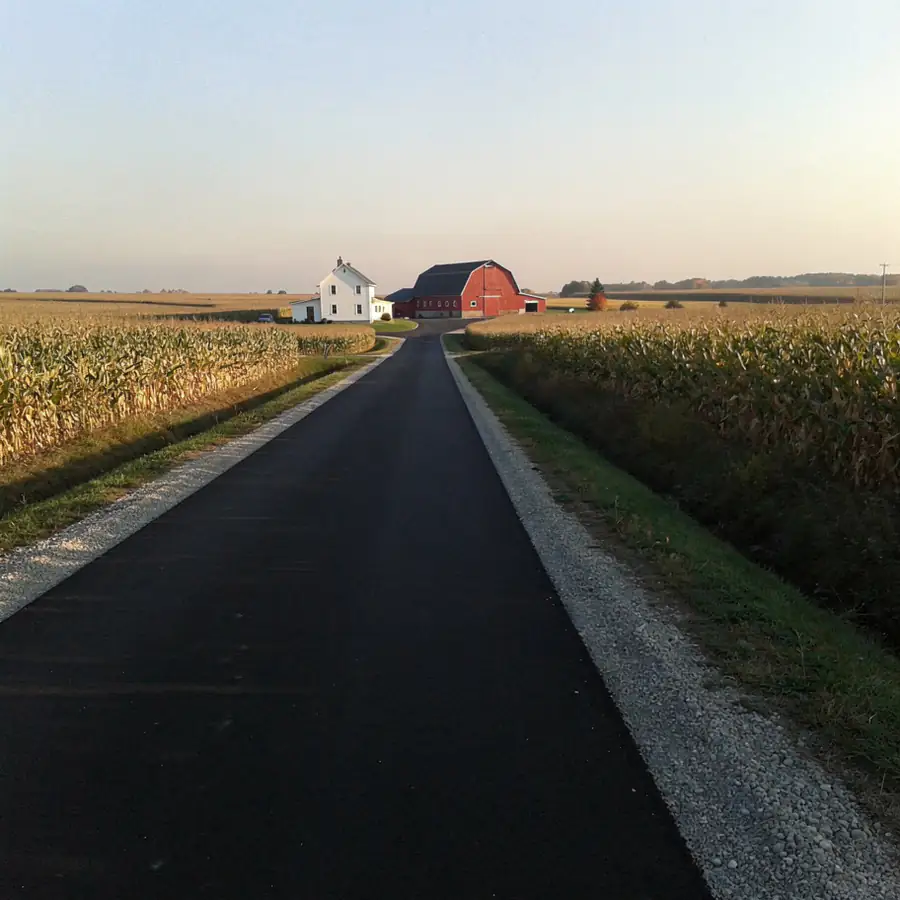
Long lanes to farmhouses, barns and country homes, often 100 to 500 m from the road. Traffic is light most days and very heavy at harvest, which is why base depth matters more here than asphalt thickness.
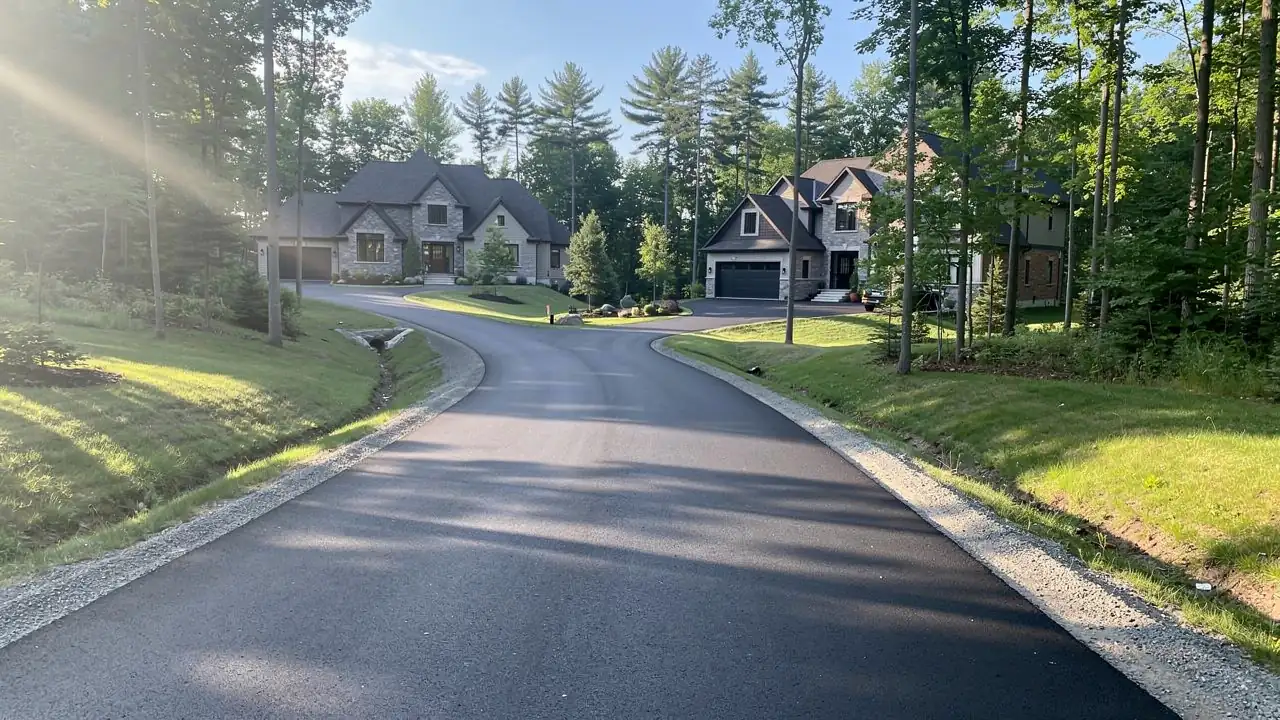
Lanes, private roads and yards
Kitchener Asphalt Paving Pros paves private roads, long rural laneways and industrial yards across Waterloo Region and Wellington County. That includes farm lanes in the townships, shared roads in condo and estate subdivisions, and truck yards where tractor-trailers turn all day.
These jobs are closer to road building than to driveway paving. A 300 m lane needs a crown, working ditches and a culvert the road authority approves, and a yard needs pavement that can take a loaded trailer pivoting in place.
We have built lanes and yards since 2013, in hot mix asphalt for daily or heavy traffic and in compacted recycled asphalt where traffic and budget are lighter. This page sets out both options, including the honest drawbacks of recycled asphalt.
What we pave
We pave four kinds of private road, and each is built differently because the traffic on it is different.
Long lanes to farmhouses, barns and country homes, often 100 to 500 m from the road. Traffic is light most days and very heavy at harvest, which is why base depth matters more here than asphalt thickness.
Internal roads owned by a condo corporation or shared by several homes. They carry garbage trucks, moving vans and fire trucks, so they get the same two-lift structure as a commercial drive lane.
Shared roads around lakes such as Puslinch Lake and private roads through wooded lots. Tree roots, shade that keeps the surface damp and seasonal high water are the usual problems.
Yards for landscapers, excavators, trucking firms and equipment dealers. Pavement here takes trailer turns, loaded dump trucks and dropped equipment, and some areas are better left as gravel or concrete.
Township lanes
Rural lanes in Woolwich, Wellesley, Wilmot and Puslinch usually fail from water, not traffic. A lane with no crown and filled-in ditches stays wet under the surface, and every freeze-thaw cycle breaks it up from below.
Before pricing a lane we walk its full length and note where water crosses, where the ditches run and whether the culvert at the road is crushed or too small. Many old gravel lanes have been topped up for decades and already carry a thick, if uneven, stone base we can regrade and reuse.
We shape the lane with a crown, or a one-way cross slope of about 2%, so water runs off the edges into the ditches. Ditches that have filled in are reshaped so they sit below the bottom of the new base.
Combines, grain carts and manure tankers cut the inside of every bend. We widen curves and the lane mouth, and build granular shoulders so tires that drop off the edge do not break it away.
On roads in Woolwich and Wellesley, Old Order Mennonite horse-and-buggy traffic wears asphalt edges with steel wheels and hooves where lanes meet the road. We thicken and compact those edges and finish the apron to the township's entrance standard.
Truck yards
Tractor-trailer yards need an engineered pavement: two lifts of HL8 binder under an HL3 surface on a deep granular base, sized by the site engineer. A trailer turning tightly on its axles twists the surface, called pivot shear, and thin pavement shoves into ridges and tears within a season.
The worst spots in any yard are predictable, so we build for them.
Site plan approval, insurance certificates and phasing for working yards that cannot shut down are covered on our commercial paving page.
Build options
Most private roads get two lifts of hot mix on a two-layer granular base, while low-traffic rural lanes can use compacted recycled asphalt for roughly a third to half the price. The table compares the four structures we build.
Two lifts let us correct the lane's profile in the first lift and lay a smooth surface with the second. The HL8 binder carries the load, the HL3 surface seals out water, and offsetting the joints between lifts stops water tracking straight down.
On a long lane we pave full width in one pass where the paver allows, so there is no centre joint to open up in the first winter.
Reclaimed asphalt pavement, also called RAP or millings, is old asphalt ground up, then spread, graded and compacted like gravel. At $1.50 to $3.00 per square foot it costs far less than hot mix and gives off much less dust than gravel once it binds, which suits farm lanes and light-traffic yards.
The downsides are real: it is never as smooth or tight as hot mix, edges ravel, potholes still form, and quality depends on where the millings came from. It can stay loose in its first season until sun and traffic knit it together, and plows pull it up until then, so we roll it hard and suggest plow shoes or a raised blade.
A lane sheds water best with a crown in the centre and about 2% fall to each side, or a single cross slope where the lane runs across a hill. Ditches need to sit lower than the bottom of the granular base, or water stays in the stone and freezes.
Where surface water crosses the lane, a cross culvert under it costs less than repairing a washout every spring.
| Option | Use | Base | Asphalt layers | Life |
|---|---|---|---|---|
| Two-lift hot mix | Private roads, condo roads, busy lanes, light yards | 150 mm Granular A over 300 mm Granular B | 50 mm HL8 + 40 mm HL3 | 20 to 30 years with regular maintenance |
| Single-lift hot mix | Car-only estate lanes on a sound base | 150 to 200 mm Granular A | 60 mm HL3 | 15 to 25 years with maintenance |
| Engineered heavy-duty | Tractor-trailer yards | Engineered design | Two HL8 lifts + HL3 | Set by the engineer's design |
| Recycled asphalt (RAP) | Rural farm lanes, budget yards, overflow parking | Existing lane base, regraded and topped up | Compacted millings, not hot-laid | Needs regrading and top-ups every few years |
Our process
A lane or yard goes through six stages, and most of the work happens before any asphalt arrives.
We walk the full length, measure width and grade, and mark drainage problems, soft spots and the culvert. Ontario One Call locates are booked before any digging.
Topsoil and sod are stripped where the lane will be widened at bends or the entrance. We mark low branches that a raised dump box would hit so they can be trimmed before paving day.
Soft sections are dug out and rebuilt with Granular B and A, with geotextile over wet clay. Culverts are replaced to the road authority's size, bedded and backfilled before the base goes over them.
The base is graded to its crown or cross slope and compacted in lifts with a vibratory roller. On long lanes we check grade at regular intervals so the finished surface does not ripple.
Hot mix is laid full width where the paver allows, to avoid a centre joint, and rolled while above about 85 C. Long lanes are paved in a planned sequence so trucks never back over fresh mat.
Granular shoulders are built up flush with the new edge so the pavement is supported. A lane without shoulders breaks off at the edges within a few winters.
Pricing
Hot mix private roads and laneways typically cost $4.50 to $7.50 per square foot before HST, and recycled asphalt lanes $1.50 to $3.00. A 200 m lane that is 3.6 m wide covers about 7,750 square feet, so roughly $35,000 to $58,000 in hot mix or $11,600 to $23,300 in recycled asphalt.
Yards are priced from the engineer's design, area by area, so the truck turning zone and the staff parking show up as separate lines on the quote.
FAQ
Rural owners and yard operators ask these questions on most site visits.
Plan for about 4 to 5 m (13 to 16 ft) of travel width where farm equipment uses the lane, against about 3 to 3.6 m (10 to 12 ft) for cars only. Widen the bends and the entrance, add a turnaround near the buildings, and if the lane is the fire access to a house, ask the township about its minimum width.
Yes, if the gravel base is sound, well drained and deep enough. We regrade it, add Granular A where it is thin, compact it and pave, digging out soft or rutted sections first, the same approach we use for asphalt driveway paving over gravel.
Usually the property owner pays for and maintains the entrance culvert, while the road authority sets its size and approves it. Rules differ between townships, counties, the Region and MTO, so we check with yours before any culvert work.
Yes, if the structure is designed for them. That means a deeper Granular B subbase, HL8 binder under the surface and an engineered design for regular tractor-trailer traffic, because a 60 mm single lift on a thin base will rut under the first harvest.
Recycled asphalt is rougher than hot mix, ravels at the edges and needs regrading and topping up every few years. It works well on a light-traffic rural lane; for driveway-scale millings jobs, see our asphalt resurfacing and millings service.
Free quote
Send the lane length and width, the road it meets and what drives on it, and we will walk it within 2 to 3 business days. Call 548-457-2043; we are WSIB covered and insured, and every quote lists base depth, lifts and mix by section.