Plaza and retail lots
Damage starts at the entrances, the drive-thru lane and behind the building where delivery trucks back up to the doors. Those areas usually get a heavier section than the customer stalls.
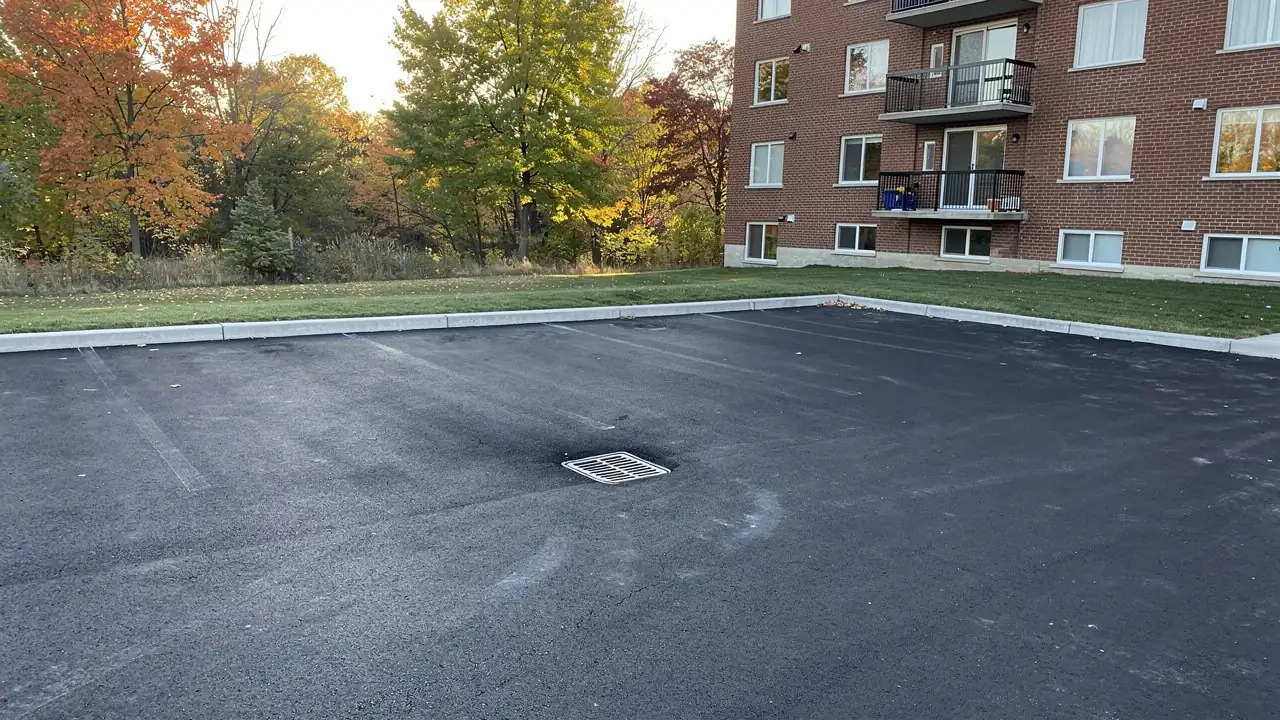
Asphalt parking lots since 2013
Kitchener Asphalt Paving Pros paves new asphalt parking lots, resurfaces worn ones and rebuilds lots whose base has given out. We work for plaza owners, condo corporations, offices, schools, churches and industrial sites across Kitchener, Waterloo and Cambridge.
Two things decide how long a lot lasts: whether water leaves the surface, and whether the pavement is thick enough where trucks drive. A lot can look fine in the stalls and still be failing in the fire lane, at the dumpster pad or around every catch basin.
After 14 seasons we read those patterns quickly. The scope we recommend, from a 40 mm overlay to a full dig-out, comes from probing the base and watching where water sits after rain, not from the age of the lot.
Lots we pave
We pave every kind of private parking lot, and each type wears out in its own way. Knowing where a lot is likely to fail tells us where to spend the budget.
Damage starts at the entrances, the drive-thru lane and behind the building where delivery trucks back up to the doors. Those areas usually get a heavier section than the customer stalls.
Visitor lots and internal drives see slow, constant traffic and tight plow turns. The weak spots are usually the transition onto the garage ramp and the corners where plowed snow melts and refreezes all winter.
These lots carry peak loads at set times, such as bus loops, drop-off lanes and Sunday services. Accessible stalls and the route to the door are what visitors notice first when they crack or hold water.
Staff parking is often built like a plaza lot, while the truck court beside it needs a far thicker section. Yards that carry tractor-trailers are covered on our industrial yard and private road paving page.
Choosing the scope
Resurface when the damage is in the top layer only, reconstruct when drive lanes show alligator cracking, rutting or soft spots, and build new where there is no pavement yet. Where the condition is unclear, we open a test pit at the edge to see the base before deciding.
| Scope | When it fits | What is removed | Typical downtime |
|---|---|---|---|
| New lot | Bare land, gravel lots or an expansion onto grass | Topsoil and organic soil, down to firm subgrade | The whole new area stays closed until paving is done |
| Mill and overlay (resurfacing) | Grey, ravelled or lightly cracked surface over a sound base | The top 40 to 50 mm of old asphalt, milled and sent to recycling | One section at a time, the shortest closure of the three |
| Full reconstruction | Alligator cracking, rutting, sinking or ponding across drive lanes | All old asphalt and the failed base, down to firm subgrade | One section at a time, longest per section because base work comes first |
Most plaza and condo lots take 2 to 5 working days in total, because larger lots are phased rather than closed. Many lots end up as a mix: overlay on the stalls and full-depth reconstruction in the drive lanes.
An overlay over a failed base cracks again along the old pattern within a few winters, which is why reflective cracking through an overlay is excluded from our warranty. Where only a few areas have failed, our asphalt patching and pothole repair crews can replace them full depth at $6 to $12 per square foot and buy time before a resurface.
Drainage and loads
Most parking lot failures come from water that does not drain and pavement that is too thin for the trucks using it. Fix both at the design stage and the rest of the lot largely looks after itself.
Every part of the lot is graded at a minimum 2% fall toward a catch basin, a swale or the curb line, so no stall holds water after rain. Large lots get a cross slope plus shallow swales that gather water and carry it to the basins.
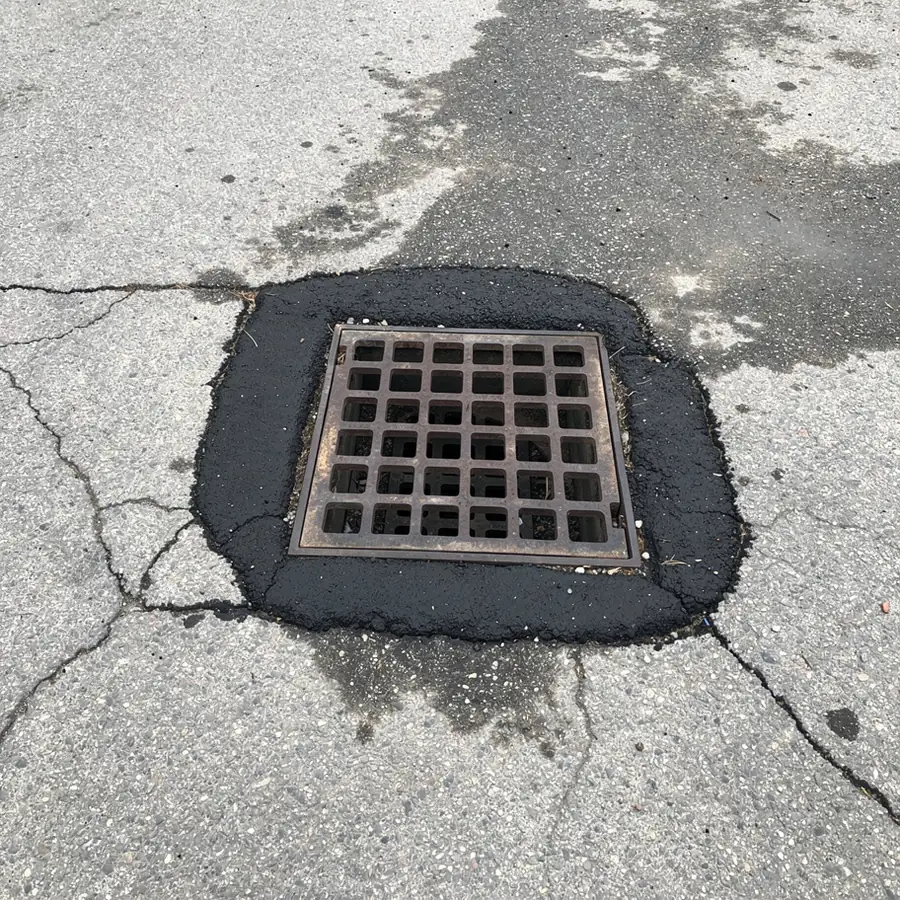
Sunken rings around catch basins are the most common defect we see. The frame settles or the backfill washes into the structure, so the frame is reset to the new grade, the backfill is compacted and the ring is paved full depth in HL8 and HL3.
One loaded front-end garbage truck stresses the pavement more than a full day of cars, and it stops on the same spot every week. Dumpster pads, loading areas and main drive lanes get 150 mm of Granular A over 450 mm of Granular B, with 60 to 75 mm of HL8 under 40 mm of HL3.
Car stalls get 50 mm of HL8 and 40 mm of HL3 on 150 mm of Granular A over 300 mm of Granular B. Splitting the lot this way puts the money where the loads are.
Accessible stalls belong on the flattest part of the lot, closest to an accessible entrance, with a firm, level route to the door. Under Ontario's Design of Public Spaces Standards, Type A van-accessible spaces are at least 3,400 mm wide, Type B spaces at least 2,400 mm and access aisles at least 1,500 mm, so we grade those areas flat before paving.
Stall lines, aisle hatching and the accessible symbol are painted by the line painting contractor you use, or one we coordinate with. Paths from the lot to the entrance are built through our asphalt walkways and ramps service.
Our process
A resurfacing or reconstruction runs in this order, one phase at a time, so part of the lot is always open. How phase maps and tenant notices are planned is set out on our commercial paving page.
We measure the lot, check existing grades and mark every failed area, catch basin and low spot. Phases are set so each section can be closed, paved and reopened without blocking the others.
A cold planer removes the top 40 to 50 mm of old asphalt, or the full depth in reconstruction areas, and the millings go to recycling. Milling at curbs and entrances lets the new surface meet them flush instead of leaving a lip.
Soft areas are dug out, lined with geotextile where the subgrade is wet clay, refilled with Granular B and A and compacted. Catch basin frames are reset to the new finished grade.
SS-1 tack coat goes on milled surfaces and cut edges, then the paver lays the HL8 binder course where the design calls for it. Rollers compact it while the mix is still above about 85 C.
The HL3 surface lift is laid with its joints offset from the binder below and rolled to a tight, closed finish. Joints between phases are cut back to a clean vertical edge and tacked so they do not open in the first winter.
Each section reopens to slow traffic once it has cooled and to parked cars after 48 to 72 hours. Your line painting contractor follows once the surface is ready for markings.
Approvals
Resurfacing or rebuilding a lot in its existing footprint usually needs no planning approval, while a new lot or an expansion usually does. Added hard surface changes how much rain runs off the property, so cities and townships review grading and stormwater through site plan approval.
Expect the engineer's plan to show catch basin locations, pipe sizes and sometimes an oil and grit separator or underground storage that limits how fast water leaves the site. We price and build to those drawings.
A new entrance onto a Regional road needs a Region of Waterloo access permit, and dug-out soil falls under Ontario Regulation 406/19. Who issues each approval, and which parts we handle, is listed on our commercial paving services page.
Pricing
Parking lot paving in Kitchener typically costs $2.75 to $11.00 per square foot before HST, depending on scope. A mill and overlay sits at the low end and a full reconstruction with new base at the high end.
| Scope | Typical price per sq ft | What pushes it up |
|---|---|---|
| Mill and overlay | $2.75 to $4.50 | Soft spots to dig out first, many catch basins, a thicker overlay |
| New lot on new base | $5.00 to $8.50 | Poor subgrade, extra Granular B, heavy-duty truck sections |
| Full reconstruction | $7.00 to $11.00 | Deep excavation, geotextile, soil haul-away, large heavy-duty areas |
As an example, a mill and overlay on a 20,000 square foot plaza lot, roughly 60 stalls, works out to about $55,000 to $90,000 before HST.
Beyond the scope, five things move the price: total area, how much base repair the lot needs, the number and thickness of lifts, how many phases the lot is split into, and work outside normal hours. Small lots cost more per square foot because a paver, rollers and trucks cost the same to bring in for 5,000 square feet as for 50,000.
Every proposal prices each area separately, so you can see what the truck lanes cost against the car stalls and phase the work by budget if you need to.
FAQ
These are the questions owners and property managers ask most often when they are budgeting a lot.
Most plaza and condo lots take 2 to 5 working days. Larger lots and full reconstructions take longer, and phasing spreads the work over more days while keeping part of the lot open the whole time.
Car areas need about 90 mm of asphalt in two lifts: 50 mm of HL8 under 40 mm of HL3. Truck lanes, loading areas and garbage pads need 100 to 115 mm, using 60 to 75 mm of HL8, on a deeper Granular B subbase.
Cars can park after 48 to 72 hours, and longer during a heat wave. Light traffic can cross a section once it has cooled, but parked cars with turned wheels leave scuffs in soft asphalt, and those marks are not a warranty defect.
Yes. Shallow dips can be heated and reshaped with infrared asphalt repair, while a basin with a settled frame or washed-out backfill needs the ring cut out, the frame reset and the area repaved full depth.
Free proposal
Send the address, a rough size or a site plan, and whether the lot must stay open, and we will walk it within 2 to 3 business days. Call 548-457-2043 seven days a week; we are WSIB covered and insured, with certificates sent before we start.