Parking lot perimeters
A continuous curb along the lot edge stops cars rolling onto lawns and braces the pavement edge. On lots that slope toward a neighbour, it also keeps runoff on your own property and headed for your drains.
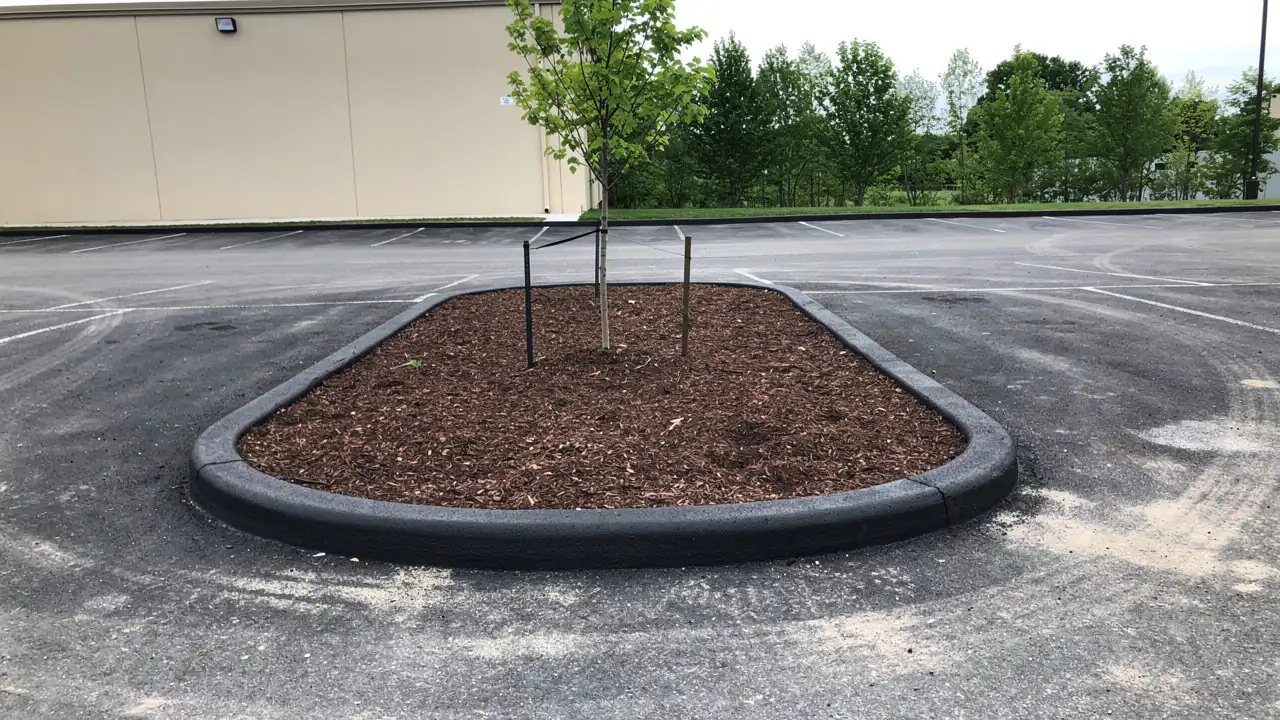
Extruded asphalt curbing
Kitchener Asphalt Paving Pros installs machine-extruded asphalt curbs on parking lots, private roads and driveways across Waterloo Region. A curb machine presses hot mix into a continuous profile on top of the pavement, so there are no forms, no digging and no week of curing before the curb can do its job.
Property managers use curbs to outline islands, stop cars at the edge of the lot and send runoff to a catch basin instead of a building. Homeowners use them along driveway edges where a lawn keeps getting driven over.
We have paved and edged commercial lots since 2013. Most curb repairs we are called about trace back to one of two causes: the curb was laid on a dirty or cold surface and never bonded, or a snowplow caught it square on.
Where curbs go
We extrude curbs on new pavement right after paving, and on existing asphalt that is sound and clean. These are the four places we install them most, on properties from Kitchener to Waterloo, Cambridge and Guelph.
A continuous curb along the lot edge stops cars rolling onto lawns and braces the pavement edge. On lots that slope toward a neighbour, it also keeps runoff on your own property and headed for your drains.
Curbed islands guide traffic through drive aisles and protect light standards and trees. Shapes are marked out on site and extruded in one continuous pass where the radius allows, often as part of our parking lot paving work.
Curbs on condo and subdivision private roads mark the edge for plows at night and carry water to catch basins. Our private road paving often includes curbing in the same contract.
A low rolled curb along a driveway stops tires breaking the edge and keeps lawn and mulch off the asphalt. It suits long driveways and the inside of curves, and can be added during asphalt driveway paving.
Curb profiles
We extrude three profiles: a barrier curb with a near-vertical face, a mountable curb with a sloped face, and a low wedge berm for water. Height and face shape decide whether a vehicle can cross it and how much water it holds back.
Choose a barrier curb where you want cars to stop. It holds back the most water of the three, but a plow blade catches it most easily, so it needs markers in winter.
A mountable curb shows drivers the edge but lets a fire truck, delivery van or plow ride over it without damage. On fire routes and narrow private roads it is usually the safer choice.
A wedge berm is a low hump that steers sheet flow along the pavement to a catch basin, a swale or a downspout outlet. Plows pass over it easily, which makes it the longest-lived profile through our winters.
| Profile | Typical height | Face | Best use |
|---|---|---|---|
| Barrier curb | About 150 mm (6 in) | Near-vertical, slightly battered | Lot perimeters, islands, head of stalls |
| Mountable or rolled curb | About 100 mm (4 in) | Sloped, easy to drive over | Driveway edges, lot entrances, fire routes |
| Wedge berm | About 50 to 75 mm (2 to 3 in) | Low and gently sloped | Steering runoff to drains or away from buildings |
Asphalt or concrete
Asphalt curbs cost less, go in faster and are easier to repair, while concrete curbs last longer and stand up to plow strikes better. We install asphalt curbs only, and when a site plan calls for concrete we coordinate with a concrete curb contractor.
| Factor | Extruded asphalt curb | Concrete curb |
|---|---|---|
| Installed cost | $15 to $30 per linear foot before HST | Usually higher per foot, with forms and excavation |
| Installation | Extruded on top of the pavement and firm once cool, the same day | Formed or slip-formed, then several days of curing |
| Durability | Softens slightly in summer heat and wears faster under plows | Rigid and long-lived on a good base |
| Snowplow damage | A square hit can shear a section off | Chips and spalls, but rarely moves |
| Repair | Cut out and re-extrude a section in a short visit | Saw-cut, re-form and pour, at higher cost |
| Best for | Private lots, islands, berms, driveway edges | Municipal standards, high-traffic edges, site plans that require it |
Municipal roads and many site plans specify concrete curb and gutter, so extruded asphalt curbing is mainly a private-property product.
Our process
Bond is everything with an extruded curb, because it sits on the pavement rather than in the ground. A curb laid on a dusty, damp or cold surface looks fine on day one and slides off at the first plow strike.
We mark the curb line with paint and check that water will flow along it to an outlet rather than pond against it. Gaps are left wherever water must pass through to a catch basin.
The strip under the curb is swept and blown clean of dust, sand and loose stone. We do not extrude on wet pavement or on a surface too cold to bond.
SS-1 asphalt emulsion tack coat goes down along the curb line so the hot curb mix fuses to the pavement below. On older, oxidized asphalt we may cut a shallow key into the surface for extra grip.
The curb machine is loaded with hot mix and drives itself forward as it compresses the mix through a profile mould. It lays a dense, continuous curb with no joints over long runs.
Ends, entrance tapers and tight radii are finished by hand with heated tools so they match the profile and bond like the rest. Ends are tapered so plow blades and tires slide past instead of catching.
The curb firms up as it cools, usually within hours. Keep vehicles off it until then, and keep heavy trucks from mounting tight islands for the first few days.
Winter
Most asphalt curb damage in Waterloo Region happens in winter, when a plow blade hits a curb face square on. Prevention comes down to choosing the right profile and telling the plow operator where the curbs are.
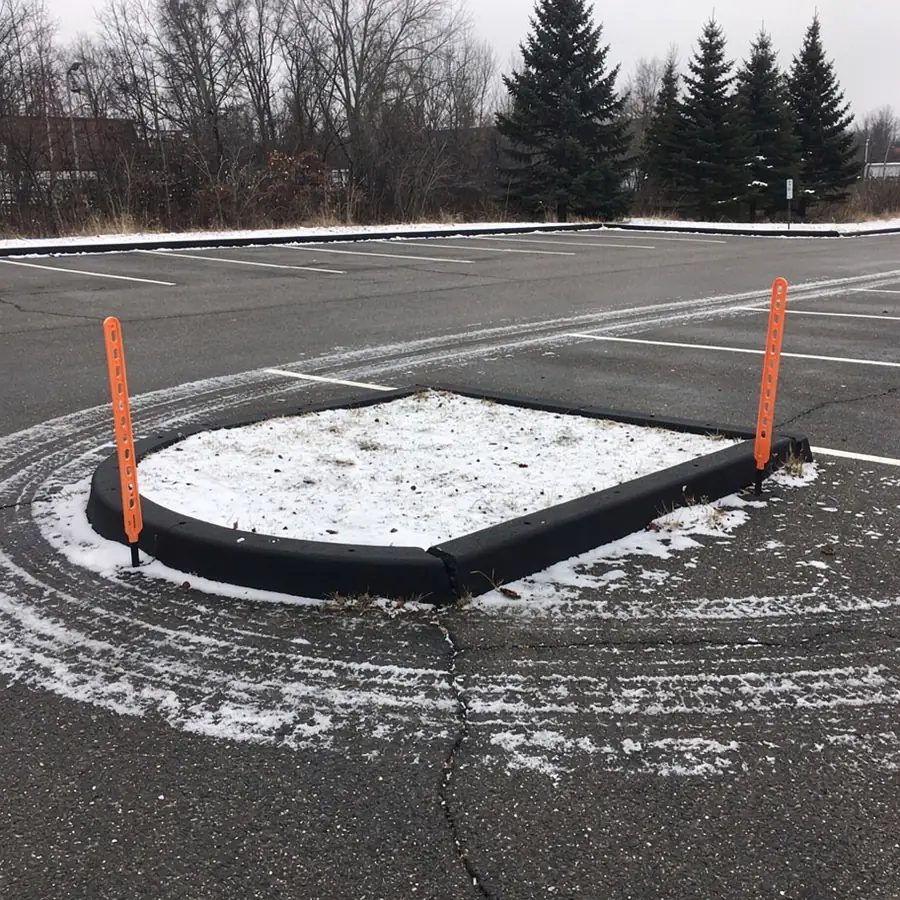
Put fibreglass edge markers at curb ends and corners before the first snowfall, and walk the site with your plow contractor in the fall so they know which curbs are barriers and which are mountable. Tapered ends and mountable profiles at plow entry points shed a blade instead of catching it.
When a section does break, we cut it back to sound curb and re-extrude it, usually in the spring repair round. Plow damage is not a workmanship defect, so it falls outside our warranty, but the repair is quick.
Pricing
Extruded asphalt curbs typically cost $15 to $30 per linear foot before HST. A barrier curb around a 60 m (about 200 ft) run of islands and lot edge comes to roughly $3,000 to $6,000.
Many owners add curbs to a resurfacing job or to repair work through our asphalt repair services, which shares the trucking and setup. Larger programs for plazas and condos are planned through our commercial paving team.
FAQ
Property managers and homeowners ask these questions most often about curbing.
A well-bonded extruded curb kept clear of plow strikes commonly lasts 10 to 15 years. Square plow hits and curbs laid on dirty or cold pavement are what cut that short, and both can be prevented.
Yes, as long as the asphalt under the curb line is sound, clean and dry. Cracks along the line are sealed first through our crack filling and sealing service, because a curb cannot bond to crumbling pavement.
Yes. We cut out the broken piece back to firm curb, clean and tack the base, and re-extrude a new section in the same profile so it ties into the old curb at both ends.
They do not need it, but sealing curbs with the rest of the lot every 2 to 3 years keeps the colour even and slows surface wear. Our asphalt sealcoating crews coat curbs and pavement in the same visit.
Free quote
Send a site plan or a photo with the curb line marked and the profile you have in mind, and we will confirm it on a site visit within 2 to 3 business days. Call 548-457-2043; we are open 7 days a week.