Mon to Sat 7:00am to 9:00pm, Sun 9:00am to 9:00pm

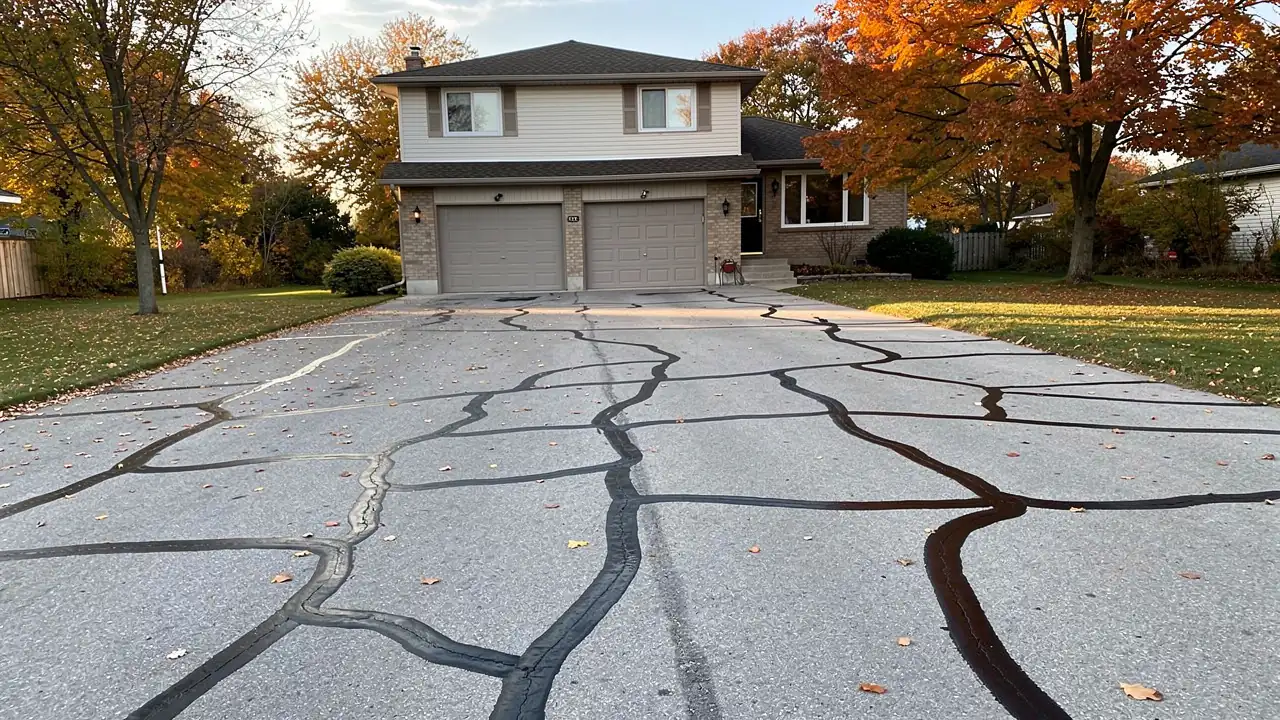
Hot pour sealed cracks on asphalt driveway

Hot-pour rubberized sealant

Asphalt Crack Filling and Crack Sealing in Kitchener

Kitchener Asphalt Paving Pros fills and seals cracks in asphalt driveways, parking lots and private roads with hot-pour rubberized sealant, melted on site and pressed into clean, dry cracks. It is the least expensive repair we offer and the one that saves the most later, because every open crack is a path for water into the base.

Homeowners usually book driveway crack sealing as a single visit, often just before a sealcoat. Property managers, condo corporations and plaza owners book us each spring or fall to seal the new cracks that every winter opens across their lots.

Over 14 seasons we have sealed cracks on Kitchener clay, sandy Waterloo lots and gravel-based rural lanes. The driveways that reach their full 15 to 25 year life are almost always the ones whose cracks were sealed early.

Our services

Asphalt Crack Filling and Sealing Services

We seal cracks on any asphalt surface that carries cars or trucks, as a one-time visit or a yearly program. Crews travel from Kitchener to Waterloo driveways and lots, paving and repair work in Guelph and the townships in between.

Driveway crack sealing

A typical driveway is drivable again 30 to 60 minutes after the last crack is sealed. Most homeowners pair it with sealing the whole surface.

Parking lot and condo road programs

Each spring or fall we seal the cracks that opened over the past winter, so footage stays low every year. Lots are done in sections so stalls stay available.

Private roads and laneways

Long lanes crack along their edges and centre seams. We seal them and point out where the edge needs stone support before it breaks off.

Prep before sealcoating

Sealer cannot bridge an open crack, so every driveway sealing and sealcoating job we do starts with crack work.

Causes

Why Asphalt Cracks in Southern Ontario

Asphalt cracks here because it is a flexible material asked to survive hot summers, deep cold snaps and wet clay. Five causes account for almost every crack we seal.

Soil changes which causes dominate. On the sandy Waterloo Moraine under west Kitchener and Waterloo, cracks are mostly thermal; on the clay till found across much of Kitchener, settlement and frost add to them.

Oxidation

Sun and air dry out the asphalt binder, turning the surface grey and brittle. Brittle asphalt develops fine surface cracks long before it carries any structural damage.

Thermal contraction

Asphalt shrinks in a cold snap, and when it cannot shrink any further it splits straight across. These transverse cracks open in January and close in July, every year.

Freeze-thaw

Water that gets into a crack freezes, expands and widens it. Our asphalt repair guide covers how that cycle turns a crack into a pothole.

Base settlement

Backfill beside new foundations, old utility trenches and soft clay pockets settle over time, and the asphalt cracks above them. Settlement cracks often follow the line of the trench or garage wall.

Unsupported edges

Where no curb, lawn or stone shoulder holds the edge, tires push it outward and cracks form a few centimetres in from the side.
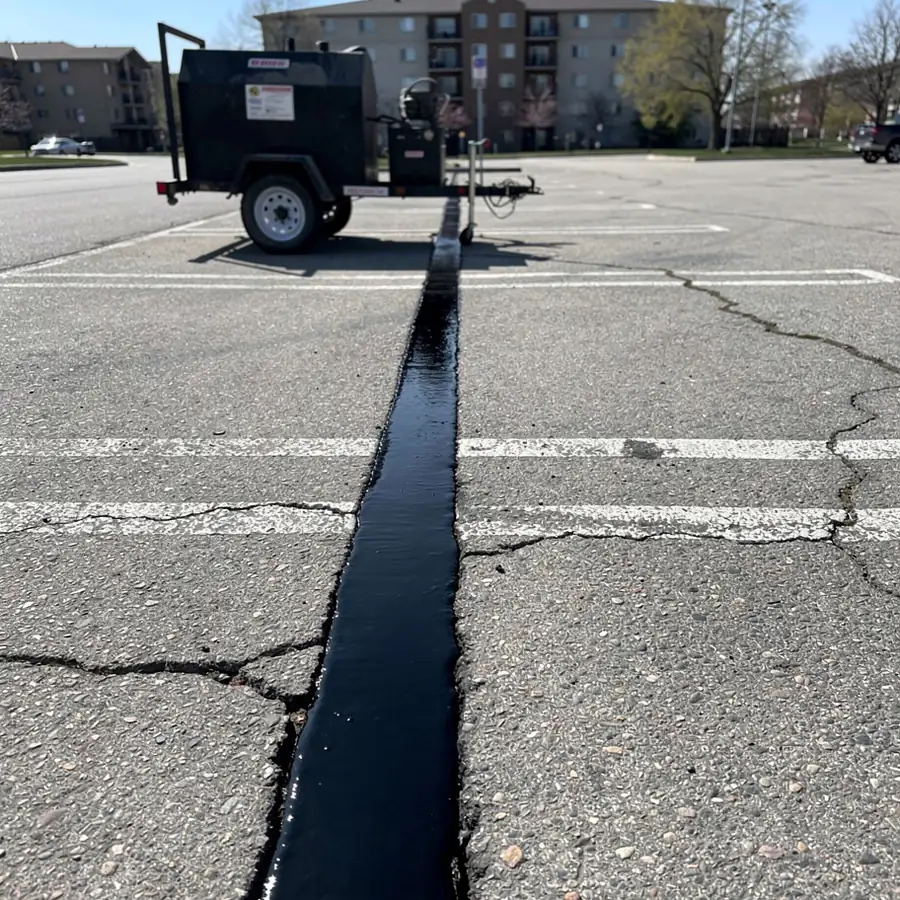
Routed transverse crack in parking lot

Know the difference

Crack Filling vs Crack Sealing

Crack filling suits cracks that barely move between seasons; crack sealing suits working cracks that open and close with temperature. Filling places material into a cleaned crack, while sealing first routes the crack into a uniform reservoir so the sealant can stretch without tearing.

Most driveways need both: sealing for the transverse thermal cracks and filling for the rest. We mark each crack on site and price the two separately.

Crack filling and crack sealing compared
FeatureCrack fillingCrack sealing
Crack movementLittle or none between summer and winterOpens in cold, closes in heat (a working crack)
RoutingNone; cleaned and dried onlyRouted to a reservoir about 19 mm by 19 mm (3/4 in)
MaterialHot-pour rubberized sealant; cold-pour emulsion only for hairline cracksHot-pour rubberized sealant, ASTM D6690 type
FinishSqueegeed flush or a narrow bandFilled flush or with a thin overband across the edges
Expected lifeAbout 2 to 4 yearsAbout 3 to 5 years, often longer
Typical useLongitudinal, block and settlement cracksTransverse thermal cracks and reflective cracks in overlays

Identify your cracks

Crack Types and What Each One Needs

Each crack pattern points to a different cause, so the pattern tells us the treatment. Use these four descriptions to identify what is on your driveway or lot.

Hairline and Thermal Cracks

Hairline cracks are surface shrinkage and can be filled, then protected by a sealcoat. Thermal cracks run straight across the pavement every few metres and widen each winter, so they are routed and sealed once they reach about 6 mm (1/4 in).

Longitudinal and Edge Cracks

Cracks running lengthwise often follow a paving seam or a weak, unsupported edge. We seal them and, where the edge is moving, add compacted stone along the side so it stops spreading.

Reflective Cracks in Overlays

An overlay laid over cracked asphalt often shows the old cracks again within a few years. They move like thermal cracks and are sealed the same way; our asphalt resurfacing page explains how prep reduces them.

Alligator Cracking Is Not a Crack Sealing Job

Cracks joined into small blocks like reptile skin mean the base underneath has failed. Sealant cannot hold broken pieces together, so we quote full-depth asphalt patching instead, or replacement if the area is large.

Materials

The Sealants We Use

We use hot-pour rubberized crack sealant that meets an ASTM D6690 type specification, the standard for hot-applied joint and crack sealants on asphalt and concrete pavement. It is a blend of asphalt, polymers and rubber that stays flexible well below freezing and sticks to the crack walls as they pull apart.

The sealant is melted in an oil-jacketed melter-applicator. Hot oil circulating around the kettle heats the sealant evenly without scorching it, and an agitator keeps the blend consistent from the first crack to the last.

  • Hot-pour rubberized sealant: for every working crack and most non-working cracks wider than a hairline.
  • Cold-pour emulsion filler: only for small hairline cracks, usually right before a sealcoat.
  • Backer material or clean sand: packed into very wide cracks so the sealant is not poured deeper than it can perform.

Hardware-store bottles and tubes of cold-pour filler are water-based emulsions that shrink as they dry. They sit in the crack as a thin, stiff skin that pulls away from the walls the first time the crack opens in a cold snap, which is why they rarely last a season.

Our process

Our Crack Sealing Process

Clean, dry crack walls are what make sealant stick, so most of the process is preparation. These are the six steps on every crack sealing job.

  1. Walk and mark

    We walk the surface, mark which cracks are working and which are stable, and measure the total linear footage for the quote.

  2. Route working cracks

    A crack router cuts a clean, square reservoir along each working crack. The extra width gives the sealant room to stretch without tearing when the crack opens.

  3. Clean and dry with a hot-air lance

    A hot-air lance blasts out dust, sand and loose stone and dries and warms the crack walls. Sealant poured into a damp or dusty crack lets go within months.

  4. Apply the sealant

    Sealant is pumped from the melter through a heated wand and fills each crack from the bottom up, so no air is trapped underneath.

  5. Overband or squeegee flush

    On lots, a thin overband across the edges seals the crack shoulders. On plowed surfaces and driveways we often finish flush, so blades and shovels slide over it.

  6. Cool and reopen

    The sealant firms as it cools, and the surface is ready to drive on within 30 to 60 minutes.

Timing

Best Time of Year for Crack Sealing

Spring and fall are the best times for crack sealing, roughly April to early June and September to October. Cracks are about halfway between their widest and narrowest then, and the pavement is usually dry.

  • Peak summer heat: the asphalt has expanded and cracks are at their narrowest, so too little sealant goes in and it tears when they reopen in winter.
  • Deep cold: cracks are at their widest, so the sealant is squeezed up into a raised ridge in summer that tires and plows pull out.
  • Wet days: sealant will not bond to damp crack walls, so we reschedule after rain or heavy dew.
  • Late fall: sealing before the first hard freeze keeps water out of the base for the whole winter.

Fall booking also suits property managers, since the cracks sealed in October are the ones that would otherwise become April's potholes.

Pricing

Crack Sealing Cost

Crack filling a typical residential driveway costs $250 to $600 before HST. Commercial hot-pour crack sealing runs $1.00 to $2.50 per linear foot, with routing priced as an extra.

Crack sealing prices, before HST
JobTypical priceWhat changes it
Residential driveway$250 to $600Total crack length, width and how many need routing
Commercial hot-pour sealing$1.00 to $2.50 per linear footCrack width, density and traffic control
RoutingExtra, quoted per footNumber of working cracks

Yearly programs keep each visit small, because only the cracks that opened since last year need sealing. Waiting three or four years means paying for all of them at once, plus the patches where water got in.

FAQ

Crack Repair Questions

These are the crack questions we get most often on driveway and lot visits.

How do you fill big cracks in an asphalt driveway?

Cracks wider than about 25 mm (1 in) are cleaned, packed with backer material or clean sand to within a short depth of the surface, then topped with hot-pour sealant. If the edges are crumbling or the crack has sunk, it is no longer a crack and needs asphalt patching.

How long does crack sealant last?

Routed hot-pour sealant usually lasts about 3 to 5 years, and filled cracks about 2 to 4. Cold-pour bottle fillers from a hardware store often fail within a single winter.

Should cracks be sealed before sealcoating?

Yes. Sealcoat is a thin film that does not bridge cracks, so we seal them first and then apply coal-tar-free sealcoating over the whole surface.

Will the sealed cracks be visible?

Yes, as black lines on grey asphalt, which some owners like and some do not. A sealcoat over the whole driveway afterward makes the surface one even colour.

Can I seal driveway cracks myself?

You can fill hairline cracks with a cold-pour product, but it will need redoing most years. Working cracks need routing, a hot-air lance and hot-pour sealant to last, which is equipment most homeowners do not own.

Fall booking

Schedule Crack Sealing Before Winter

September and October are the last reliable weeks to seal cracks before the freeze, and the slots fill quickly. Book a visit and we will measure your cracks and price filling and sealing separately in writing.

  • Hot-pour rubberized sealant, routed where cracks move
  • Drivable within 30 to 60 minutes of the last crack
  • WSIB covered and fully insured, with certificates on request
Shop
324 Stirling Ave S, Kitchener, ON N2M 3H6
Monday to Saturday
7:00am to 9:00pm
Sunday
9:00am to 9:00pm
Call 548-457-2043Free Quote