Parking Lots: New, Resurfaced and Reconstructed
Our parking lot paving covers new lots on fresh granular base, mill and overlay where the base is sound, and full reconstruction where drive lanes have alligator cracked.
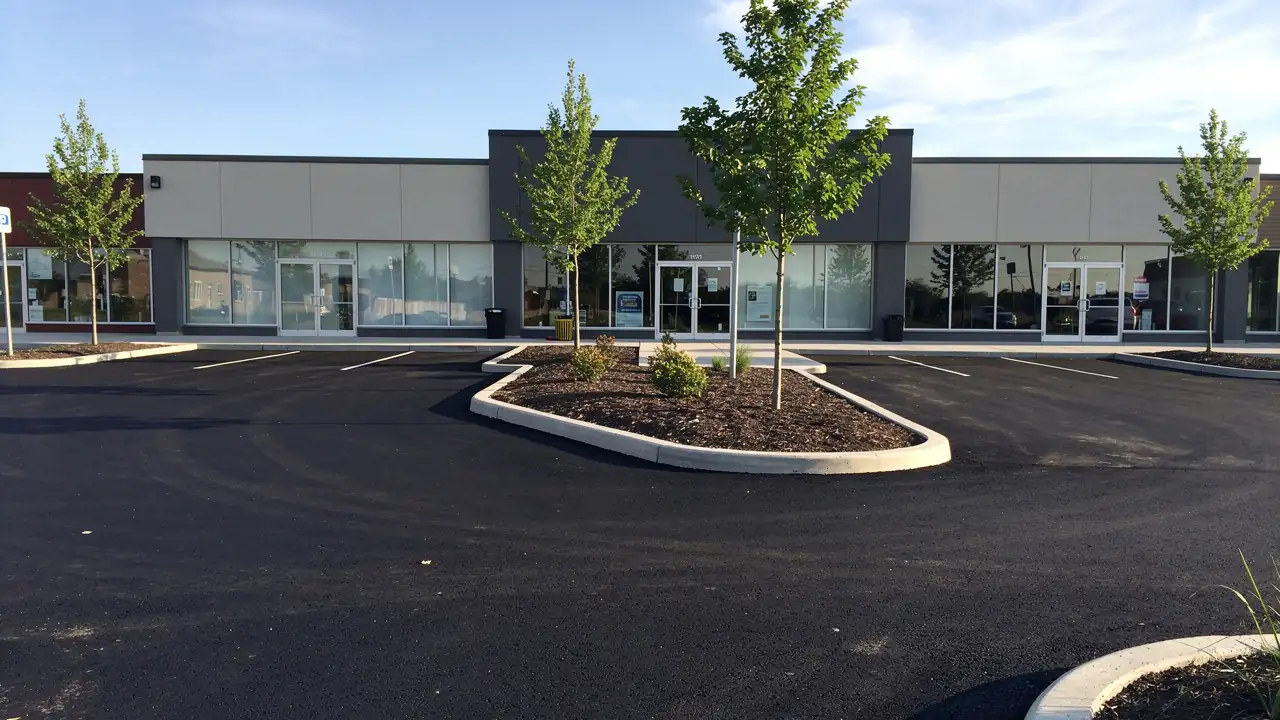
Commercial paving since 2013
Kitchener Asphalt Paving Pros builds, rebuilds and maintains commercial asphalt for property managers, condo boards and facility owners across Waterloo Region. Plaza lots, condo roads, church lots and truck yards have been part of our work since 2013, within more than 2,500 completed jobs.
Commercial paving differs from a driveway in three ways: heavier loads, a property that has to stay open during the work, and a paper trail that must satisfy an insurer, a board or a site engineer. This page explains how we handle all three, then points you to the page for each type of commercial job.
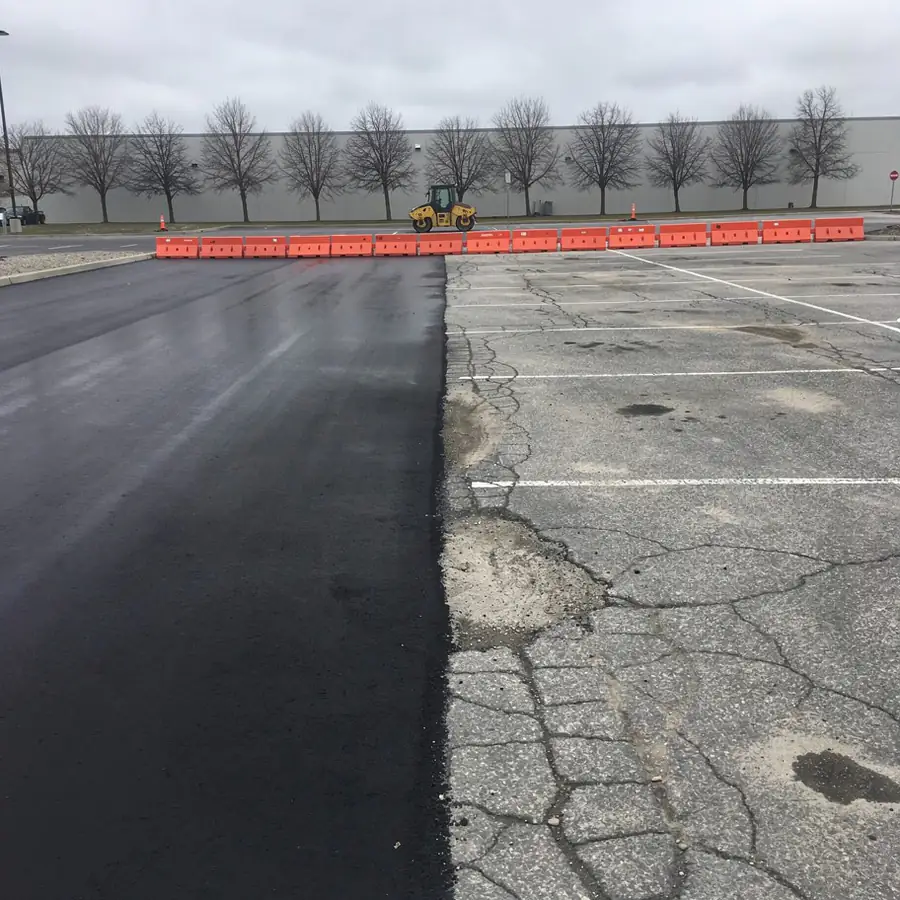
When we assess an older lot, the failures are almost always in the same places: the garbage pad, the drive lane inside the entrance and the ring around each catch basin. We price the heavy-duty fix for those spots and a lighter section everywhere else, so the budget goes where the loads are.
Commercial services
Each commercial service has its own page with the build specs, process, failure points and pricing for that job. Start with the one that matches your property.
Our parking lot paving covers new lots on fresh granular base, mill and overlay where the base is sound, and full reconstruction where drive lanes have alligator cracked.
We pave private roads, rural laneways and industrial yards, from condo roads to truck courts, in two-lift hot mix or in recycled asphalt for low-traffic farm lanes.
Machine-extruded asphalt curbs outline islands and lot edges and steer runoff toward catch basins. They sit on top of sound pavement, so no excavation is needed.
Poured asphalt speed bumps and humps slow drivers in lots and on private roads, and stay put under a plow blade where bolt-down rubber bumps get torn out.
Paths from parking to entrances, built to the AODA exterior path rules where they apply. Widths and slopes are set out on our asphalt walkways and ramps page.
Potholes, catch basin dips, cracks and faded surfaces go through our asphalt repair services. Owners who want that work on a schedule can use an annual maintenance plan, described further down this page.
Build specs
A commercial pavement is two layers of hot mix on a two-layer stone base, and the thickness of each layer depends on the heaviest vehicle that uses it. HL8 is the binder course, a coarser mix with 19 mm stone that carries the load.
HL3 is the surface course, a denser Ontario mix under OPSS 1150 with 13.2 mm maximum stone that seals out water and gives a smooth finish. Below both sits Granular A crushed stone over a Granular B subbase, built to OPSS 1010.
| Use | Granular base | Binder course | Surface course |
|---|---|---|---|
| Car parking stalls and aisles | 150 mm Granular A over 300 mm Granular B | 50 mm HL8 | 40 mm HL3 |
| Delivery lanes, loading areas and garbage pads | 150 mm Granular A over 450 mm Granular B | 60 to 75 mm HL8 | 40 mm HL3 |
| Private roads and laneways | 150 mm Granular A over 300 mm Granular B | 50 mm HL8 | 40 mm HL3 |
| Tractor-trailer yards | Engineered design | Two HL8 lifts | HL3, thickness set by the site engineer |
Large sites, new developments and anything carrying tractor-trailers take their pavement design from the owner's civil engineer or a geotechnical report, and we build to that design. Where the engineer asks, the base is proof-rolled and tested to 100% Standard Proctor density before any asphalt goes down.
Two lifts also give better joints. We offset the seams so a joint in the HL8 never sits directly under a joint in the HL3, and we spray SS-1 tack coat between lifts so the layers bond into one pavement.
Phasing
Most commercial lots can be paved in phases so the property never fully closes. We divide the lot into sections, keep at least one entrance and drive aisle open, and shift traffic as each section is finished and cooled.
Before the start date you get a phase map showing which stalls close on which days, plus notice wording to send tenants, residents or customers. Plazas usually time phases around the anchor tenant's hours, while condos usually want the garage ramp and the visitor stalls done on different days.
Milling, base repairs and catch basin work can run early mornings, evenings or weekends. Overnight paving depends on an asphalt plant producing hot mix after hours, so we confirm plant hours before promising a night pour.
Our office answers the phone seven days a week, Sundays included, so a property manager can reach a person if a tenant has a problem mid-job.
Vendor paperwork
Before we mobilize, property managers receive a certificate of insurance naming the owner, manager or condo corporation as additional insured, plus a current WSIB clearance certificate. Both usually go out the same day you ask.
If your vendor portal asks for additional safety documents, tell us which ones at quote stage so they are ready before the start date rather than holding up mobilization.
Maintenance plans
An annual maintenance plan books the inspection, crack sealing and sealcoating on a fixed schedule so small defects are fixed before water reaches the base. A commercial lot on an engineered base lasts 20 to 30 years with regular maintenance, and far less without it.
| Plan | What it includes | Best for |
|---|---|---|
| Inspect | Spring walk-through, written condition report with photos and a marked-up site plan, and a priced repair list for next season's budget | Owners planning capital work or a condo reserve fund study |
| Inspect and seal | Everything in Inspect, plus yearly hot-pour crack sealing and spot patching of potholes | Lots under about 10 years old with sound drive lanes |
| Full care | Everything above, plus power washing and commercial sealcoating every 2 to 3 years and infrared repairs at catch basins and settled seams | Plazas, condos and offices where appearance and tenant complaints matter |
Plans are priced from the same unit rates as one-off work, all before HST: commercial hot-pour crack sealing at $1.00 to $2.50 per linear foot, sealcoating at $0.18 to $0.30 per square foot and power washing at $0.08 to $0.20 per square foot. Infrared repair runs at a day rate of $2,500 to $4,000, so we group catch basin and seam repairs into full days.
Line painting is not part of any plan because we do not paint lines. After a sealcoat, stalls and arrows are repainted by the line painting contractor you already use, or one we coordinate with so the timing lines up.
FAQ
Property managers and boards ask these questions most often before approving a paving contract.
Yes, nearly every commercial lot we pave stays partly open. We split it into sections, keep an entrance and drive aisle usable, and move traffic as each section is finished; the parking lot paving page shows the order of work inside each phase.
Inspect it every spring, seal cracks every year and sealcoat every 2 to 3 years. New asphalt gets its first sealcoat after about 12 months, once it has cured, and an annual plan books all three so none is forgotten.
Yes. We send a certificate of insurance naming you as additional insured and a current WSIB clearance before we mobilize, usually the same day you ask, because most property managers need both in their vendor file.
No, we do not do line painting. We pave, repair and seal, and the line painting contractor you use, or one we coordinate with, lays out stalls, arrows and accessible markings after us.
A lot built on an engineered base lasts 20 to 30 years with regular maintenance. An overlay on a sound structure adds 8 to 15 years, and skipping crack sealing is the quickest way to shorten either figure.
Site assessment
Send the property address, approximate lot size, property type and preferred timing, and we will book a site assessment within 2 to 3 business days. You get a written, itemized proposal within 2 business days of the visit, with a phase plan if the property has to stay open.