Tennis courts
Single and multi-court builds for homes, clubs and schools, paved on a laser-graded base sized for full run-off. We set the plane so water leaves the court across its width or along one side.
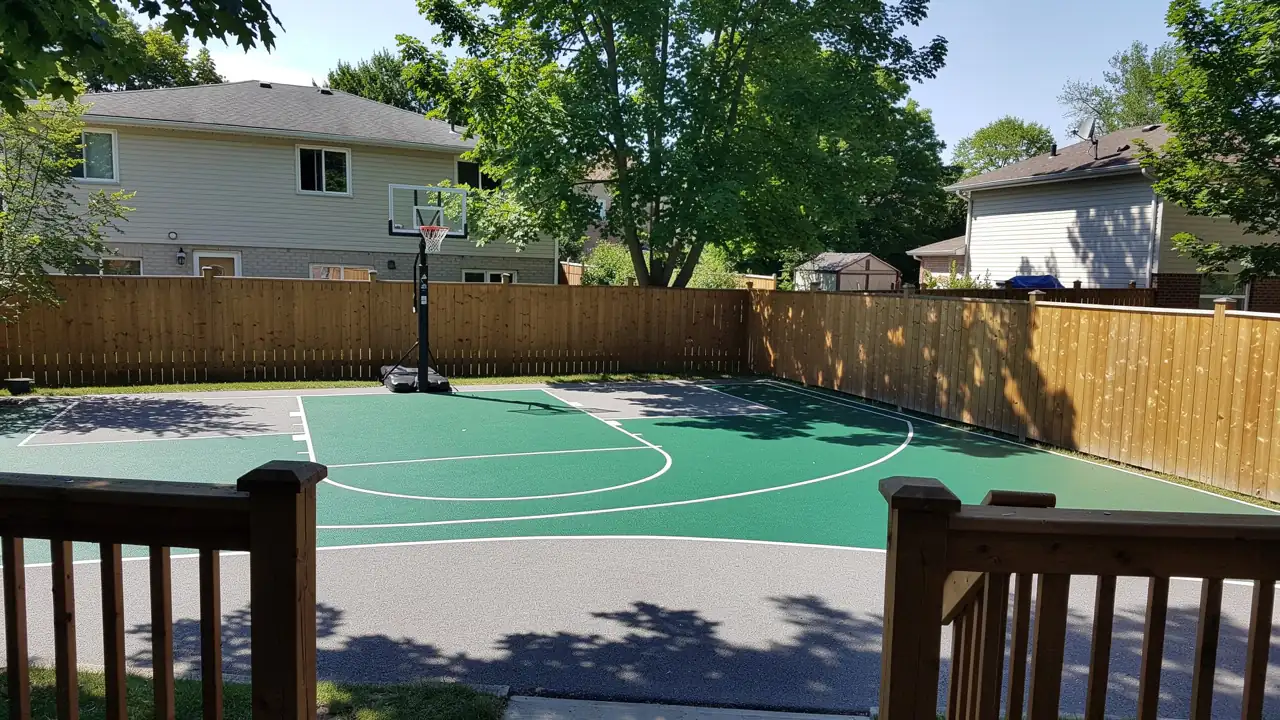
Laser-graded sport courts
Kitchener Asphalt Paving Pros builds the asphalt for tennis courts and basketball courts at homes, schools, clubs and condo properties. We excavate, build the granular base, laser-grade it and pave two lifts of hot mix, finishing with a fine HL3F surface.
A court is held to a much tighter standard than a driveway. It has to drain on one flat plane with no crown, no dips and no birdbaths, because a puddle the size of a dinner plate stops play for hours and leaves a stain in the colour coat.
The acrylic colour coating, playing lines, nets and hoops come from a sport surfacing contractor we coordinate with. Our job, after 14 seasons of precision paving, is to hand that contractor a base that is level, cured and ready for their system.
Courts we pave
We pave four kinds of court project. Fencing, acrylic surfacing and line marking are done by specialist trades scheduled around our paving, not by us.
Single and multi-court builds for homes, clubs and schools, paved on a laser-graded base sized for full run-off. We set the plane so water leaves the court across its width or along one side.
School and park-style full courts, sized to the space available, with hoop footings placed before paving so the poles stand straight for decades.
The most common residential court, often built as an extension of a driveway or set in the back yard. Where it joins the drive, we pave both together through our asphalt driveway paving service.
Old courts with cracks through the colour coat, low spots or heaved corners. We tell you whether the base can be kept and overlaid or needs digging out.
Sizes
A recreational tennis court needs about 36.6 m by 18.3 m (120 by 60 ft) of paving, while a backyard shooting pad can be as small as 6 m by 6 m (20 by 20 ft). The paved area is always larger than the lines, because players need run-off room around them.
A full FIBA court is 28 m by 15 m, which few backyards can fit, so most homeowners build a half court. The FIBA three-point line sits 6.75 m from the basket, so a court about 9 m deep fits the key and the top of the arc, while 6 m by 6 m covers the key and short shots.
The doubles lines measure 23.77 m by 10.97 m, but players chase balls well behind the baseline and outside the sidelines. A paved area of about 36.6 m by 18.3 m leaves 6.4 m behind each baseline and 3.66 m beside each sideline, the usual recreational standard.
| Court type | Playing area | Recommended total paved area |
|---|---|---|
| Tennis, doubles | 23.77 m by 10.97 m (78 by 36 ft) | About 36.6 m by 18.3 m (120 by 60 ft) |
| Basketball, full court (FIBA) | 28 m by 15 m (92 by 49 ft) | About 32 m by 19 m (105 by 62 ft), with 2 m of run-off |
| Basketball, high school size | 25.6 m by 15.2 m (84 by 50 ft) | About 28 m by 17 m (92 by 56 ft) |
| Half court, large backyard | About 9 m by 9 m (30 by 30 ft) or more | Same, plus about 1 m to the fence |
| Shooting pad, minimum | About 6 m by 6 m (20 by 20 ft) | Same; fits the key and short jump shots |
Precision grading
A court drains on a single tilted plane at about 1% slope, so water runs off one side or corner with no crown and no low spots. A driveway can hide a shallow dip; a court cannot, because standing water makes it slippery and unplayable.
We set grade with a rotating laser and a receiver on the grading equipment, so the base is cut to the same plane across the whole court. Both asphalt lifts are then laid and rolled to that plane, with the top lift in HL3F, the fine-graded surface mix.
After paving we flood the court and let it drain. Any puddle deeper than about 1.6 mm (1/16 in) after an hour of drying is marked and corrected before the colour coat goes on.
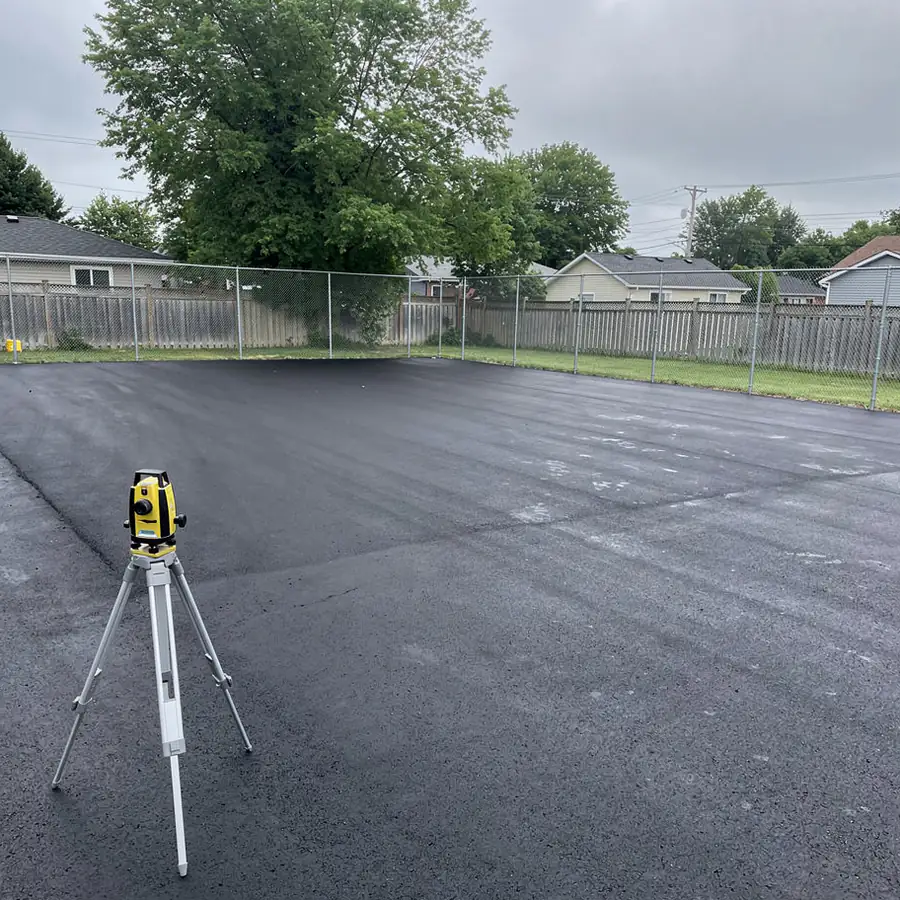
Our process
A court goes from bare ground to a surface ready for coating in six stages. Each one is checked against the laser plane before the next begins.
We strip topsoil and dig to firm subgrade, deep enough for the full base and two asphalt lifts, and haul spoil to an approved site. Ontario One Call locates come first.
On the clay and silt till common in Kitchener, non-woven geotextile goes down first so the base cannot pump into the soil. Sandy sites on the Waterloo Moraine often do not need it.
We place 150 to 200 mm of Granular A, laser-grade it to the court's single plane and compact it in lifts until it no longer moves under the roller.
The first lift of HL3 hot mix is laid and rolled to plane. It carries the load and takes out any small variation left in the base.
The fine-graded HL3F lift goes on top with tight, overlapping roller passes, so the surface is closed and smooth enough for acrylic coating.
We flood the court, check for birdbaths once it drains and correct low spots before handing it over to cure.
Curing
New asphalt must cure before acrylic colour coating goes on, and most coating makers ask for at least 14 to 30 days, with many surfacers preferring 28 days or more. The surfacer follows the minimum set by the maker of the acrylic system they apply.
Coating too early traps oils and moisture still leaving the fresh asphalt, which causes blistering, poor adhesion and soft spots under foot traffic. Warm weather shortens the wait, and cool fall weather lengthens it.
That is why we prefer to pave courts in late spring or summer, so the court can cure and be coated in the same season. A court paved in late October may have to wait until the following spring for its colour coat.
Pricing
Paving only, a backyard basketball half court typically costs $6,000 to $12,000 and a tennis court $45,000 to $80,000, before HST. Fencing, acrylic colour coating, nets, hoops and lighting are priced separately by those trades.
| Factor | Effect on price |
|---|---|
| Court size | Paved area sets the tonnage of base stone and both asphalt lifts |
| Excavation and spoil | Sloped yards need more cut and fill, and spoil haul-away under Ontario Regulation 406/19 |
| Soil type | Wet clay needs geotextile and extra base, while sandy moraine soils need less |
| Drainage work | A swale or drain at the low edge adds cost but protects the base |
| Access | Backyards with narrow side yards need smaller equipment and more hand work |
| Trade coordination | Footings, fence posts and conduit must be scheduled before paving day |
We build courts across Kitchener, Waterloo, Guelph and the Elora and Fergus area, where shallow limestone bedrock can mean rock removal during excavation.
FAQ
Homeowners, schools and clubs ask these questions most often when planning a court.
A good backyard half court is about 9 m by 9 m (30 by 30 ft), and 6 m by 6 m (20 by 20 ft) is the practical minimum for shooting practice. Leave about 1 m beyond the lines before a fence or garden bed so players do not run into it.
Most acrylic coating makers ask for at least 14 to 30 days of curing, and the surfacer follows the minimum for their product. Coating sooner can trap oils and moisture in the asphalt and cause blistering.
Sometimes. If the cracks come from an ageing surface on a sound base, an overlay through our asphalt resurfacing service can work, but cracks from a wet or moving base reflect back through an overlay within a few winters, so the court needs rebuilding.
No. We pave and laser-grade the court, and a sport surfacing contractor we coordinate with applies the acrylic colour coat and playing lines once the asphalt has cured.
Court quote
Send the yard or site dimensions, a few photos of the area and the court you have in mind, and we will tell you what fits and what the paving will cost. Site visits are booked within 2 to 3 business days, and we bring the fencing and surfacing trades into the plan from the first visit.